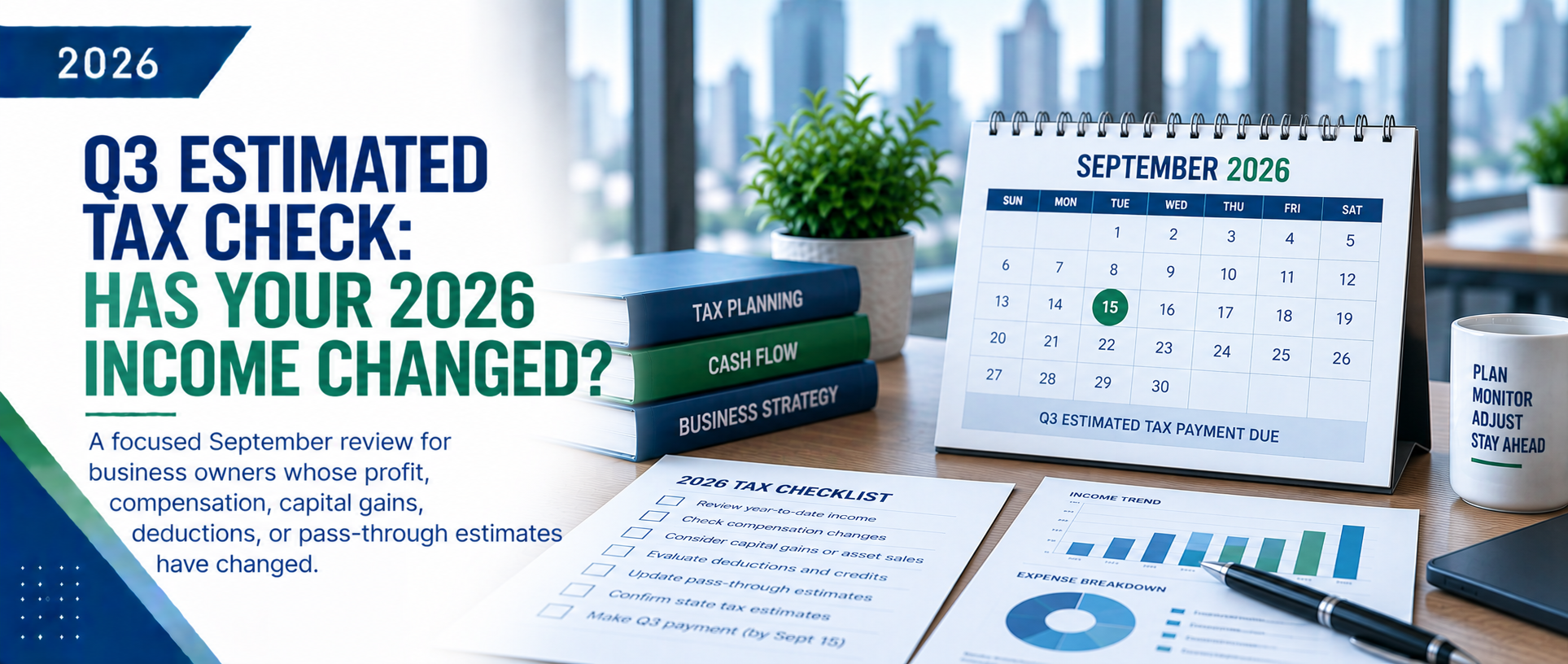
Suggested: business owner reviewing a Q3 income projection ahead of the September 15 deadline.
 –>
–>
Tax Planning | 2026 Q3 Update
Q3 Estimated Tax Check: Has Your 2026 Income Changed?
A focused September review for business owners whose profit, compensation, capital gains, deductions, or pass-through estimates have changed.
The September 15, 2026 Q3 estimated-tax deadline is a planning checkpoint—not a repeat of June. Update the full-year projection, compare the 90% current-year and 100%/110% prior-year safe harbors, and adjust the payment for changes in business profit, K-1 income, wages, gains, deductions, credits, or withholding. A safe harbor may reduce penalty risk but can still leave a balance due with the 2026 return.
1. Definition: What Is a Q3 Estimated-Tax Check?
Estimated tax is used to pay federal income tax—and, when applicable, self-employment tax—during the year when withholding is insufficient. It commonly applies to business owners, partners, S corporation shareholders, investors, and other taxpayers with non-wage income. C corporations follow separate rules.
A Q3 check updates the owner’s full 2026 tax projection before the September 15 installment. Review the complete tax picture—not just company cash distributions.
2. Why It Matters
- Timing matters: The third 2026 individual installment is due September 15. Underpayment penalties can apply by payment period even if the balance is later paid with the return.
- Penalty exposure changes: The source article notes a 7% federal underpayment rate for Q3 2026, compounded daily, and rates can change quarterly.
- Safe harbor is not full funding: Meeting a safe harbor can reduce penalty risk but may still leave a meaningful filing-season balance if 2026 income increased.
3. How the Q3 Review Works
Step 1: Refresh the Full-Year Projection
Refresh year-to-date results and project through December. Include business income, wages, interest, dividends, capital gains, retirement income, deductions, credits, withholding, and payments already made.
For partners and S corporation shareholders, estimate taxable pass-through income separately from cash distributions. K-1 income and cash received may differ materially.
Step 2: Compare the Two Main Safe-Harbor Approaches
| Approach | General Federal Target | Planning Use |
|---|---|---|
| Current-year test | Pay at least 90% of the tax shown on the 2026 return. | Useful when 2026 income is lower or a reliable projection is available. |
| Prior-year test | Pay 100% of 2025 tax; generally 110% if 2025 AGI exceeded $150,000, or $75,000 if married filing separately. | Offers a known target when the prior-year return covered 12 months, but may leave a 2026 balance due. |
Taxpayers generally avoid the individual underpayment penalty when the remaining tax after withholding/refundable credits is under $1,000 or when timely payments satisfy the applicable 90% current-year or 100%/110% prior-year test. Confirm eligibility before relying on a safe harbor.
Step 3: Determine the September Target
Under the regular installment method, the cumulative annual target is generally 75% by September 15. Subtract eligible withholding, credits, and prior estimated payments using the applicable timing rules. Do not simply divide a revised annual estimate by four.
Step 4: Address Uneven Income and State Obligations
If income is uneven—such as a business sale, large capital gain, seasonal profit, or late-year contract—the annualized-income installment method may better match payments to when income was earned. It generally requires Form 2210 Schedule AI and period-specific support.
Review state estimated taxes separately. State safe harbors, due dates, rates, entity-level taxes, and withholding rules may differ from federal requirements.
4. Simple Example
Assume Jordan’s 2025 total tax was $80,000 and prior-year AGI exceeded $150,000. The prior-year safe-harbor target is therefore $88,000 (110%). After a stronger Q3, the projected 2026 tax is $120,000, making the current-year 90% target $108,000.
The lower annual safe-harbor target is $88,000. Under the regular method, 75% = $66,000 is generally the cumulative target by September 15. If $50,000 has already been credited, the illustrative Q3 gap is $16,000.
Paying $16,000 may satisfy the illustrated safe-harbor target, but it does not fully fund the projected $120,000 tax. About $32,000 would still remain before later withholding, the January installment, other payments, and final return adjustments. Plan for both penalty protection and filing-season cash.
5. Common Mistakes and Quick Answer
- Using distributions as taxable income: Partnership or S corporation taxable income may differ from cash distributions.
- Using 100% when 110% applies: Recheck the prior-year AGI threshold before using the safe harbor.
- Paying enough annually—but too late: Estimated-tax penalties are tested by installment period.
- Failing to refresh the projection: Add gains, bonuses, new income, lost deductions, and changed credits.
- Ignoring state or entity-level obligations: Federal planning does not replace separate state analysis.
Will a Q3 Catch-Up Erase a Q1 or Q2 Underpayment?
Not automatically. A larger September payment may reduce exposure from that date forward, but an earlier-period penalty may remain. If income itself arose later, the annualized-income method may better match the required payment timing.
6. Practical Checklist: What’s Next
Work through these items before the September 15 installment.
0 of 6 complete
PNJ Perspective
Estimated-tax planning should connect year-to-date financial results, K-1 income, safe-harbor rules, withholding, state estimates, and cash flow. PNJ helps business owners update the projection and choose a payment strategy that addresses both penalty risk and the expected filing-season balance.
Technical Reference Points
- IRS: 2026 Form 1040-ES
- IRS: Publication 505
- IRS: Estimated Taxes
- IRS: Quarterly Interest Rates
- IRS: Form 2210
Disclaimer
This article provides general educational information and is not tax, accounting, or legal advice. Estimated-tax requirements, safe harbors, payment timing, and state rules depend on the taxpayer’s facts and may change. Consult a qualified adviser regarding your specific situation.