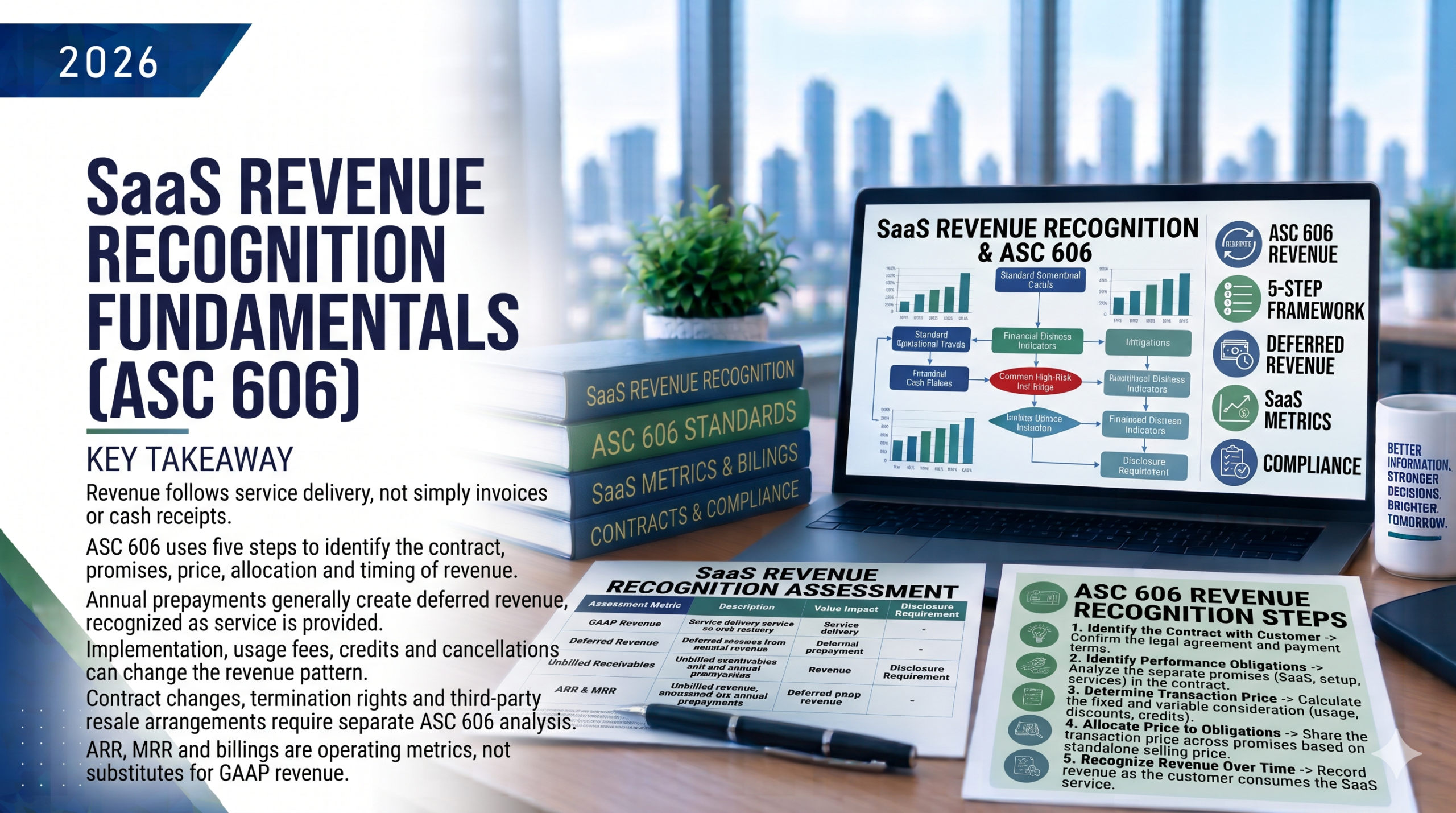
Suggested: Finance team reviewing a subscription revenue and deferred-revenue schedule on a monitor in a modern software-company office.
 –>
Accounting | Intermediate | U.S. GAAP
SaaS Revenue Recognition Fundamentals (ASC 606)
- Revenue follows service delivery, not simply invoices or cash receipts.
- ASC 606 uses five steps to identify the contract, promises, price, allocation and timing of revenue.
- Annual prepayments generally create deferred revenue, recognized as service is provided.
- Implementation, usage fees, credits and cancellations can change the revenue pattern.
- Contract changes, termination rights and third-party resale arrangements require separate ASC 606 analysis.
- ARR, MRR and billings are operating metrics, not substitutes for GAAP revenue.
1. What Is SaaS Revenue Recognition?
SaaS revenue recognition is the process of determining when and how much revenue a software-as-a-service company earns under ASC 606, Revenue from Contracts with Customers. Revenue is recognized when or as the company satisfies promised goods or services (its performance obligations) by transferring them to a customer—not merely when the customer is billed or pays.
For a typical hosted subscription, customers receive and consume access throughout the service period, so subscription revenue is generally recognized over time. More complex contracts may include implementation, support, usage-based charges or customer credits that require separate analysis.
2. Why Does the Concept Matter?
- Reliable financial statements: Recognizing annual billings immediately can overstate current revenue and understate deferred revenue.
- Better decisions: Separating earned revenue from cash collections improves interpretation of recurring revenue, margins and forecasts.
- Consistent contract treatment: Setup fees, discounts, refund rights and contract changes can materially affect the timing or amount of revenue.
- Investor and lender reporting: ARR, MRR, bookings and billings describe commercial activity, while GAAP revenue reflects performance obligations satisfied.
3. Core Components and How ASC 606 Works
ASC 606 applies a five-step model:
| Step | Key question for SaaS companies |
|---|---|
| 1. Identify the contract | Are there enforceable rights, payment terms and probable collection? |
| 2. Identify performance obligations | Are subscription access, onboarding or other services distinct? |
| 3. Determine transaction price | What fixed and variable amounts are expected, including credits or concessions? |
| 4. Allocate the price | How is consideration allocated using relative standalone selling prices? |
| 5. Recognize revenue | When or as each promised service is provided? |
Important SaaS accounting distinctions
- Subscription access: Usually recognized over the period customers receive access.
- Implementation and setup fees: A separately invoiced fee is not automatically a distinct performance obligation; assess whether it provides a distinct service.
- Usage-based fees and service credits: Evaluate the applicable terms and variable consideration rules, including the constraint on significant revenue reversals.
- Deferred revenue (contract liability): Represents consideration received or due before the related obligation is satisfied; accounts receivable is an unconditional right to payment, while a contract asset depends on a condition other than time.
- Contract modifications and cancellation rights: Added users, upgrades or revised terms may require separate-contract accounting, prospective treatment or a cumulative catch-up adjustment, depending on the remaining promises. Termination and refund clauses may affect the enforceable contract period.
4. Practical Example: Annual SaaS Subscription
ABC Cloud receives $12,000 on January 1 for continuous platform access from January through December. Assume access is a single performance obligation, service is provided evenly and there are no other contract features.
| Timing | Illustrative entry | Financial statement effect |
|---|---|---|
| January 1 | Dr Cash $12,000 Cr Deferred Revenue $12,000 | Cash increases; no subscription revenue yet |
| Each month | Dr Deferred Revenue $1,000 Cr Subscription Revenue $1,000 | One month of service recognized |
| December 31 | Deferred Revenue = $0 | Entire 12-month service delivered |
Cash was collected upfront, but $1,000 of revenue is recognized each month.
If the same customer also pays $1,000 for onboarding, the invoice label does not establish a separate performance obligation. If onboarding is distinct, allocate the contract price using relative standalone selling prices and recognize the allocated amount when or as onboarding is performed. If it is not distinct, account for it with the related subscription service.
5. Common Misunderstandings and Boundaries
- “Cash collected equals revenue.” Prepayments normally create a contract liability until the related service is delivered.
- “Every implementation fee is immediate revenue.” The service must first be evaluated for distinctness and the transaction price allocated appropriately.
- “Unbilled revenue is always accounts receivable.” It may instead be a contract asset if payment remains conditional on something beyond the passage of time.
- “All usage charges are recognized when invoiced.” Recognition follows the contractual promise and service delivered, not necessarily the billing date.
- “ARR or bookings equals GAAP revenue.” Operating measures and ASC 606 revenue serve different purposes.
- “All third-party resale billings are gross revenue.” A SaaS reseller generally reports gross revenue if it controls the specified service before transfer (principal); otherwise it typically reports its net fee or commission (agent).
6. Key Considerations and Next Steps
A sound SaaS revenue process should connect executed contracts, billing records, product usage, collections and the general ledger. Management should:
- Document contract terms and identify distinct performance obligations, including onboarding and premium support.
- Maintain a revenue and deferred-revenue schedule that reflects service periods, modifications, credits and cancellations.
- Reconcile regularly among the billing platform, customer balances, usage records and GAAP revenue.
- Review unusual arrangements, including setup fees, contract amendments, customer termination rights and third-party resale, before determining revenue presentation and timing.
How PNJ Group Can Help
PNJ Group supports SaaS companies with ASC 606 accounting assessments, deferred-revenue reconciliations, monthly close processes, reporting controls and fractional controller/CFO advisory services.
Technical Reference
- FASB ASC 606, Revenue from Contracts with Customers, including related implementation and disclosure guidance.
Disclaimer
General educational content only. Contract-specific accounting depends on the enforceable terms, performance obligations and applicable U.S. GAAP.