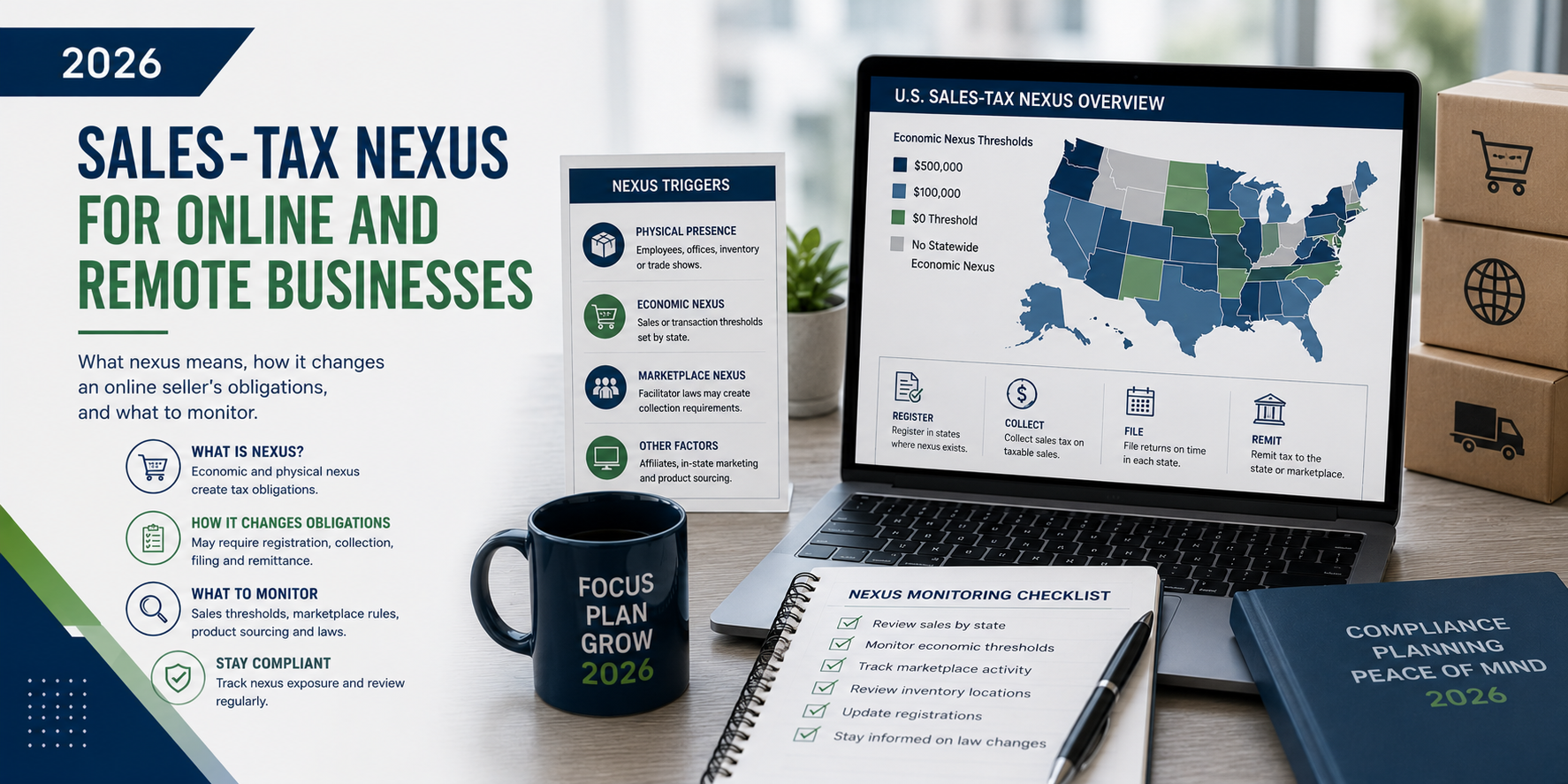
Suggested: online seller reviewing a U.S. map of state sales-tax nexus and thresholds.
 –>
–>
Tax Compliance Intermediate Practical Guide
Sales-Tax Nexus for Online and Remote Businesses
What nexus means, how it changes an online seller’s obligations, and what to monitor
Online sales can create sales-tax obligations in states where the business has no storefront. Remote employees, inventory, fulfillment activity or sales volume may establish the required connection.
That connection is sales-tax nexus—the point at which a state may require the seller to comply with its sales-tax rules.
“Remote” does not mean “outside the sales-tax system.” Once nexus exists, a seller may need to register, collect, file and remit in the customer’s state. Nexus does not automatically make every sale taxable.
1. What Sales-Tax Nexus Means for an Online Seller
Sales-tax nexus is the connection that allows a state to require seller compliance. Once nexus exists, the business must separately determine taxability, sourcing and rates.
For online businesses, nexus usually arises in two ways:
- Physical nexus: remote employees, inventory, warehouses, fulfillment centers, equipment or certain in-state activity can create nexus—even when the seller does not choose the warehouse location.
- Economic nexus: sales into a state may trigger compliance once the state’s statutory threshold is exceeded. Wayfair removed physical presence as a universal requirement.
There is no single national threshold. States differ on thresholds, measurement periods, marketplace treatment and when collection must begin.
Nexus asks where the seller must comply. Taxability asks what is taxable. Products, SaaS, services, shipping and bundled transactions may follow different rules.
2. The Practical Effect of Creating Nexus
Once nexus exists, the seller may become responsible for registration, tax calculation, returns, remittance and recordkeeping. The obligation extends beyond simply turning on tax at checkout.
| Business Area | What Changes After Nexus | Why Management Should Care |
|---|---|---|
| Registration | The seller may need a state sales-tax permit before collecting. | Registration starts an ongoing compliance relationship and filing calendar. |
| Checkout and billing | Tax must be calculated using the applicable sourcing and state/local rules. | Incorrect setup may overcharge customers or leave tax uncollected. |
| Accounting | Collected tax is recorded as a liability, not revenue, and must be reconciled. | Unreconciled balances can produce inaccurate financial statements and late remittances. |
| Returns and records | The seller may need periodic returns, zero returns, exemption support and transaction detail. | Duties continue after the first registration and may survive a low-sales period. |
The cash risk can be significant. If tax should have been collected but was not, the seller may have to fund the tax, penalties and interest because recovery from past customers is often impractical.
Nexus exposure also matters in audits, financing, due diligence and business sales. Buyers and investors may request state-by-state sales, registrations, returns and exemption support.
3. Why Online Sales Channels Require Separate Tracking
Selling through a marketplace does not eliminate the seller’s nexus analysis. Marketplace-facilitator laws may shift collection for marketplace transactions, but direct sales still require separate review.
- Direct website sales: the seller generally remains responsible for nexus and collection when a state obligation applies.
- Marketplace sales: the marketplace may collect and remit, but the seller should retain reports and confirm whether those sales count toward the state’s nexus threshold.
- Combined-channel effect: direct and marketplace sales may together trigger nexus, while the marketplace handles tax only on its own transactions.
“The marketplace handles our tax” is not enough. Track sales by destination and channel, and document who collected the tax.
4. A Focused Nexus Review for a Remote Business
Step 1: Map the Physical Footprint
Map states with remote workers, inventory, fulfillment, equipment or other physical activity. Do not limit the review to the formation state or headquarters.
Step 2: Build Destination-State Sales Reports
Report sales by customer destination and separate direct vs. marketplace channels. Retain gross, taxable and exempt sales and relevant dates.
Step 3: Apply the Current State Rule
For each state, confirm the threshold, sales base, measurement period, marketplace treatment and collection start date. Physical nexus must be evaluated separately.
Step 4: Implement the Obligation
After nexus is identified, determine taxability and sourcing, assess historical exposure, register, configure checkout and build a filing calendar. Reconcile sales-tax payable to channel reports and returns.
5. Online-Seller Example
ABC LLC sells through Shopify and a marketplace. Marketplace inventory is stored in several states, and sales into one state exceed its economic threshold.
ABC may have physical nexus from inventory and economic nexus from sales volume. Marketplace collection may cover marketplace orders, but ABC must still evaluate registration and collection on direct Shopify sales.
6. Practical Checklist / What to Do Next
Work through these items to run a focused nexus review.
0 of 7 complete
The key question is not simply, “Do we sell there?” Ask what connection exists, when it arose and what duties followed. A recurring review can identify exposure before sales tax becomes an unexpected cost.
How PNJ Can Help
PNJ can help online and remote businesses map physical and economic nexus, organize destination-state sales, separate marketplace and direct-channel obligations, assess historical exposure, coordinate registrations and maintain ongoing compliance.
Current Reference Points
- U.S. Supreme Court: Wayfair (2018)
- Streamlined Sales Tax: Remote Seller State Guidance
- Texas Comptroller: Remote Sellers and Marketplaces
- California CDTFA: Marketplace Facilitator Act
Disclaimer
This article is for general informational purposes only and does not constitute tax, legal or accounting advice. Sales-tax nexus, taxability, sourcing, registration, filing and remediation requirements vary by jurisdiction and may change. Businesses should confirm current state and local rules and consult qualified advisers regarding their specific facts.