Suggested: founders at a table reviewing a pre-opening cost register and a calendar, with a shop or office being set up behind them.
 –>
–>
Tax Practice Guide
Start Up Costs and Organizational Costs
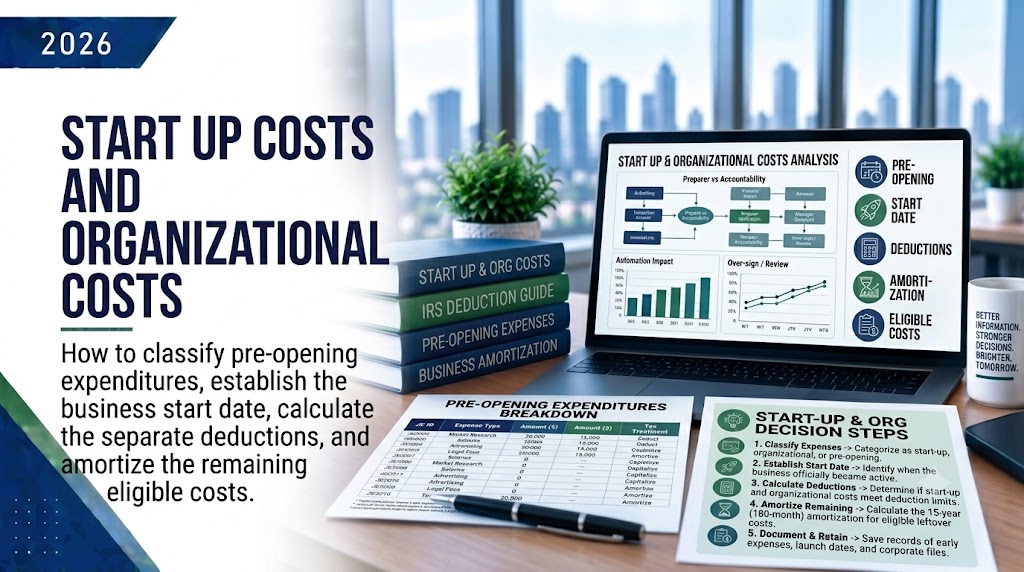
How to classify pre-opening expenditures, establish the business start date, calculate the separate deductions, and amortize the remaining eligible costs.
Not every pre-opening cost receives the same tax treatment. Start-up costs and organizational costs are separate categories, each with its own potential current deduction and 180-month amortization. Assets, acquisition costs, financing/equity costs, research, personal costs, and post-opening expenses may follow different rules. Correct classification and a supportable business-start date determine the timing and amount of the deduction.
1. Definition
Start-up costs: eligible pre-opening expenditures to investigate, create, or prepare an active business that would generally be deductible if incurred after operations begin. Examples include market/feasibility studies, pre-opening advertising, employee training, qualifying travel, and certain consulting or professional fees.
Organizational costs: direct costs of legally creating a corporation or partnership, such as state filing fees, charter/bylaw drafting, organizational meetings, partnership filing fees, and partnership-agreement work.
- Do not combine the categories: Organizational costs generally exclude stock issuance, equity fundraising, asset transfers, partnership syndication, and post-opening operating costs.
2. Why It Matters
- Separate deduction limits: A business may generally deduct up to $5,000 of eligible start-up costs and $5,000 of eligible organizational costs. Each limit is reduced dollar-for-dollar when that category exceeds $50,000, with the remaining eligible amount generally amortized over 180 months.
- Business-start date: Formation, an EIN, a lease, or a bank account does not by itself prove operations began. Use the date the business was ready and available to perform its intended activities. The wrong start month can accelerate or delay deductions and create book-to-tax differences.
3. How It Works
Step 1: Build a Pre Opening Cost Register
Create a register by vendor, date, amount, purpose, and project. Retain invoices, engagement letters, contracts, travel support, training records, and evidence of pre-opening activity. A generic description such as “start-up expense” is not enough.
Step 2: Classify Each Cost Before Calculating a Deduction
| Cost Category | Typical Examples | General Direction |
|---|---|---|
| Start-up | Market studies, pre-opening advertising, training, qualifying travel and consulting | Limited current deduction; amortize eligible remainder |
| Organizational | Charter, bylaws, partnership agreement, filing and organizational-meeting costs | Separate limited deduction; amortize eligible remainder |
| Capital asset | Equipment, furniture, acquired software, building improvements | Capitalize and recover under the applicable asset rules |
| Transaction or financing | Business acquisition, debt issuance, stock issuance, partnership syndication | Apply the specific capitalization or transaction rule |
| Other | Interest, taxes, research, personal costs, post-opening operations | Apply the separate rule for that expenditure |
Step 3: Establish the Month the Active Business Began
Use facts showing when the business was ready and available to provide its product or service. Useful evidence includes first order availability, opening date, first service engagement, operational staffing, required licensing, and delivery capability. Keep a short dated memorandum supporting management’s conclusion.
Step 4: Apply the Rules Separately to Each Eligible Category
Maintain separate schedules for start-up and organizational costs. For each category, calculate the available current deduction after the $50,000 phaseout and amortize the remaining eligible amount over 180 months from the business-start month. If one category reaches $55,000, its $5,000 immediate deduction is fully phased out; the other category is tested separately.
Step 5: Make and Support the Election
The election is generally made on the timely filed return for the year the active business begins. Reporting depends on the entity and expenditure; Form 4562 is generally used for amortization details. Review current return instructions and any available late-election relief. A taxpayer may elect to capitalize eligible costs instead, but the decision should be intentional because the election is generally irrevocable.
Step 6: Reconcile Book and Tax Treatment
Book and tax timing may differ. Maintain category-level tax schedules, book-to-tax adjustments, start-date support, and election documentation. Avoid one blended GL account called “organization costs,” which can hide assets, operating expenses, nondeductible amounts, and costs with different recovery periods.
4. Simple Example
A calendar-year corporation begins active business on July 1 after incurring $23,000 of eligible start-up costs and $9,000 of eligible organizational costs. Both categories are below $50,000, so each retains the full $5,000 current deduction.
| Category | Current Deduction | Amount Amortized | Six Months of Amortization | First Year Total |
|---|---|---|---|---|
| Start-up costs | $5,000 | $18,000 | $600 | $5,600 |
| Organizational costs | $5,000 | $4,000 | $133 | $5,133 |
| Combined | $10,000 | $22,000 | $733 | $10,733 |
Start-up amortization: $18,000 ÷ 180 = $100/month. Organizational amortization: $4,000 ÷ 180 ≈ $22.22/month. With six months in the first year, the combined deduction is approximately $10,733. Remaining balances continue over the rest of the 180-month periods.
5. Common Mistakes and FAQs
Common Mistakes
- Treating every pre-opening payment as start-up cost: separate assets, transaction costs, financing, research, taxes, interest, and personal expenses.
- Combining start-up and organizational costs: each category has its own $5,000 deduction and $50,000 phaseout.
- Using the legal-formation date automatically: support the month the business was actually ready to operate.
- Deducting the full balance in year one: amortize the eligible remainder over 180 months.
- Failing to document the election and schedules: retain the start month, detailed invoices, election support, and ongoing amortization records.
Do LLCs Have Organizational Costs?
It depends on the LLC’s federal tax classification and the nature of the cost. A multi-member LLC taxed as a partnership may have partnership organizational costs; an LLC taxed as a corporation may use corporate rules; and a disregarded single-member LLC follows rules applicable to its owner. State-law form alone does not control federal tax treatment.
What If the Business Never Opens?
The normal start-up deduction and 180-month amortization generally require an active trade or business to begin. If a project is abandoned, treatment depends on whether the costs relate to a general search, a specific business or acquisition, or another capitalization rule. Review the facts before claiming an abandonment loss or current deduction.
6. Practical Checklist and What Comes Next
| Owner | Required Action | Evidence or Output |
|---|---|---|
| Founder or operations | Confirm what the business did before opening and identify the month it was ready to operate. | Opening timeline and supporting facts |
| Accounts payable or accounting | Collect and code every pre-opening invoice by purpose rather than vendor name alone. | Pre-opening cost register and source documents |
| Controller | Separate start-up, organizational, asset, transaction, financing, research, personal, and operating costs. | Classification schedule and proposed entries |
| Legal or transaction lead | Identify formation, equity, acquisition, syndication, and financing work. | Agreements, filings, and matter descriptions |
| Tax preparer | Test eligibility and phaseouts, confirm the election, and build the 180-month schedules. | Return workpapers, Form 4562 detail, and tax schedules |
| CFO or management | Approve the business-start date and material classification judgments before filing. | Dated review and approval |
Before filing the first return, document each material cost’s purpose, timing, tax rule, calculation, and approval, and reconcile each amortization schedule to the GL and tax return annually.
How PNJ Can Help
PNJ Group can classify pre-opening costs, support the business-start date, calculate deductions/phaseouts, build 180-month schedules, and reconcile tax treatment to the books.
Official References
- IRS Publication 583
- IRS Publication 542
- Form 4562 Instructions
- Form 1065 Instructions
- Treas. Reg. §1.263(a)-5
Disclaimer
This article provides general educational information and is not tax, accounting, legal, or financial advice. Treatment depends on the entity, expenditure, business-start date, election, documentation, and applicable law. Consult qualified advisers before filing.