

Accounting & Finance
Startup Accounting Checklist: What to Set Up Before the First Transaction
A practical guide to building reliable books, controls and reporting from day one.
In brief
01 Most accounting problems begin as setup problems. Establish ownership, documentation and workflows before transaction volume makes reconstruction difficult.
02 Separate business and personal activity, use a true double-entry system and support every opening balance with independent records.
03 Decide how books, tax records, approvals and monthly reporting will operate before the business begins scaling.
A new business can create transactions before it creates an accounting system. Customer payments arrive, founders fund expenses, software subscriptions begin and vendor bills accumulate. If those activities are not classified and documented consistently, the resulting reports may look complete while giving management an unreliable picture of cash, obligations and performance.
1. Why Accounting Setup Matters
Early errors become expensive because they require someone to trace bank activity, locate missing records, determine why transfers occurred and rebuild schedules that should have existed from the start. Current records also help founders see overdue invoices, upcoming payments, available cash and operating runway.
2. Separate Business and Personal Activity
Open dedicated business bank and credit-card accounts and use them for business activity. When an owner pays a business cost personally, record both the expense and the related amount due to the owner, capital contribution or owner loan, as appropriate. When cash moves from the business to an owner, determine whether it is reimbursement, payroll, a distribution, draw or loan repayment.
Owner transactions depend on the entity type, governing agreements and documentation. Corporate reimbursements may also be subject to accountable-plan rules.
3. Select Software and Protect Access
- Double-entry bookkeeping. The system should produce a balance sheet, income statement, general ledger and trial balance.
- Data portability. Confirm that the company can export its chart of accounts, general ledger, trial balance, unpaid invoices and bills, and transaction-level reports.
- Company-controlled administration. The business should own the primary administrator account, recovery methods and billing relationship.
- Role-based security. Use multifactor authentication, individual user accounts and the least access each user needs.
- Reviewed bank feeds. Automated feeds reduce entry but can still create duplicates, omissions and transfers misclassified as revenue or expense.
4. Design the Chart of Accounts and Opening Balances
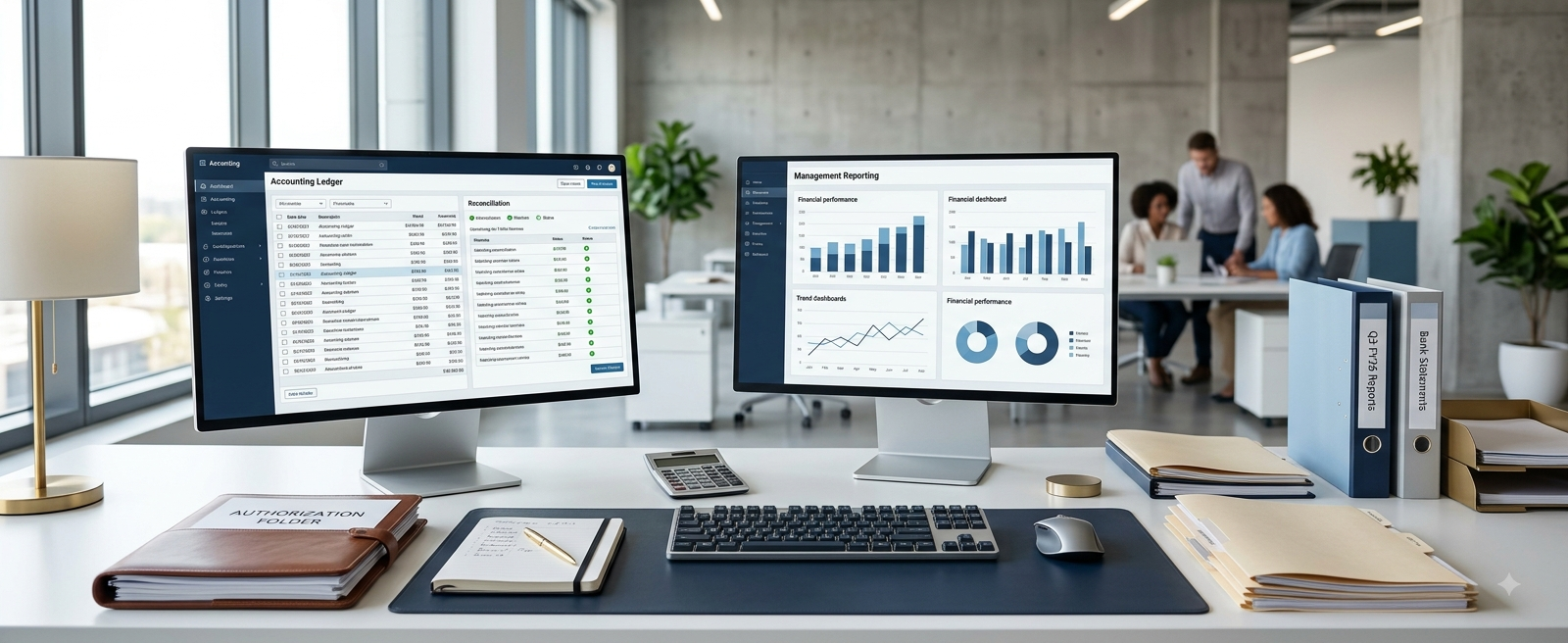
The chart of accounts should organize assets, liabilities, equity, revenue and expenses at a level that supports useful reporting. Separate economically different activity— such as owner contributions, owner loans, customer deposits and revenue—but do not create a separate account for every vendor. Vendors belong in the vendor ledger.
Every opening balance should be supported by reliable records and reconciled to independent documentation: bank accounts to bank statements, credit cards to card statements, loans to lender records, receivables to customer invoices and equity to formation and ownership records.
An entry that merely forces total debits and credits to balance does not resolve a missing or incorrectly classified opening balance.
5. Decide How the Books and Tax Records Will Be Maintained
Under the cash method, income is generally recorded when received and expenses when paid. Under the accrual method, income is generally recorded when earned and expenses when incurred. Accrual reporting becomes increasingly useful as receivables, payables, inventory, customer deposits, deferred revenue, lender requirements or investor reporting become significant.
The method used for management reporting and the federal tax method may differ. Tax-method eligibility is governed by tax rules, and changing an adopted tax method may require IRS approval or Form 3115. Discuss both approaches with a qualified adviser when configuring the books and preparing the first return.
6. Build Repeatable Workflows
- Customer invoicing. Define when invoices are issued, approval responsibilities, payment terms, collection follow-up, credits and refunds.
- Vendor bills. Define submission, receipt confirmation, approval, payment authorization and matching. Tracking bills when received improves visibility into upcoming cash needs; formal expense recognition depends on the reporting method.
- Expenses and reimbursements. Document allowable costs, receipt requirements, business purpose, submission deadlines and reimbursement timing.
- Monthly close. Assign responsibility for reconciliations, review unusual balances and produce consistent financial reports by a defined date.

7. Other Setup Decisions to Address
Address the following when they apply to the business:
- Accounting period or fiscal year and document-retention responsibilities.
- Payroll and contractor onboarding, including W-4 and W-9 collection.
- Sales-tax tracking and registrations.
- Fixed-asset capitalization and depreciation policies.
- Inventory quantities and costing procedures.
- Customer deposits and deferred-revenue treatment.
8. Startup Accounting Checklist
Use the checklist below to confirm that the foundational accounting environment is in place before activity becomes difficult to reconstruct.
Before the First Transaction
0 of 6 complete
During the First 30 Days
0 of 6 complete
Build the accounting foundation before you need to rebuild it.
PNJ helps startups establish scalable accounting systems through chart-of-accounts design, opening-balance support, workflow configuration, reconciliations, monthly close procedures, management reporting and ongoing outsourced accounting.
Talk with PNJ about an accounting-system setup review.
Sources and Professional Notes
- IRS Publication 583, Starting a Business and Keeping Records
- IRS Publication 538, Accounting Periods and Methods
- IRS Publication 15, Employer’s Tax Guide
- IRS: Recordkeeping
Disclaimer
This material is for general informational purposes only and does not constitute accounting, tax or legal advice. Appropriate accounting and tax treatment depends on the entity type, reporting framework, agreements, documentation and other facts. Consult qualified advisers before implementing or changing accounting or tax methods.