Suggested: an HR leader and a controller at a conference table at dusk, reviewing a signed separation agreement beside an equity-award report.
 –>
Accounting Practice Guide | Intermediate
Stock Based Compensation After Employee Termination
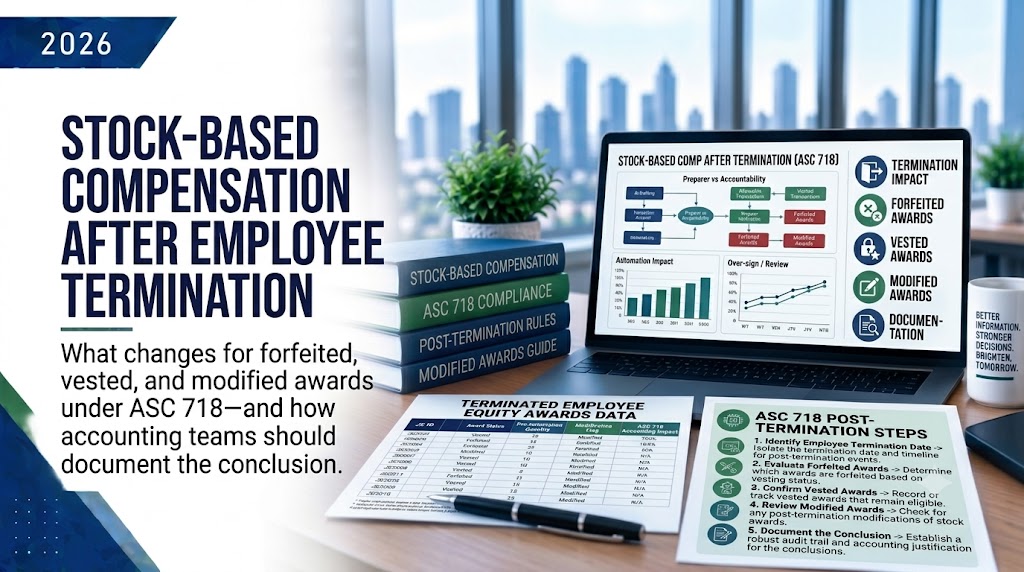
What changes for forfeited, vested, and modified awards under ASC 718—and how accounting teams should document the conclusion.
Employee termination does not create one automatic stock-compensation entry. The accounting depends on service end date, vesting status, forfeiture policy, and any change to award terms. Unvested service-based awards may require reversal; vested awards generally retain recognized cost; modified awards may create incremental or modification-date compensation cost.
1. Definition
Stock-based compensation after termination requires determining what vested, what was forfeited, what remains exercisable, and whether termination changed the award terms. The analysis applies to options, restricted stock, RSUs, and similar awards.
This guide focuses on service-based, equity-classified employee awards. Performance or market conditions, cash-settled or liability-classified awards, and continued nonemployee service may require additional analysis.
| Termination Result | Typical Accounting Direction |
|---|---|
| Unvested service award is forfeited | Apply the entity-wide forfeiture policy; reverse cost when required. |
| Award is vested and remains outstanding | Do not reverse compensation cost merely because employment ended. |
| Vested option later expires unexercised | Do not reverse previously recognized equity-classified compensation cost. |
| Terms are changed at or after termination | Screen the change under ASC 718 modification guidance. |
| Award is cash settled or changes classification | Perform separate settlement and classification analysis. |
2. Why It Matters
- Cross-functional risk. HR, legal, payroll, tax, equity administration, valuation, and accounting must use the same dates and documents so compensation expense, APIC, award counts, deferred taxes, and disclosures agree.
- Do not treat all departures alike. A routine forfeiture differs from accelerated vesting, and an exercise-window extension differs from allowing the original post-termination period to operate as written. Follow the original award terms and the specific action taken.
3. How It Works
Step 1: Identify When Service Actually Ends
Use the last date of substantive service, not automatically the payroll termination date. If the individual continues as a consultant, adviser, or transition employee, determine whether service continues for the award and which guidance applies. Document with HR and legal support.
Step 2: Read the Governing Documents
Review the plan, grant agreement, amendments, separation agreement, board approvals, and employment terms. Confirm vested quantity, vesting conditions, forfeiture provisions, exercise window, retirement/good-leaver treatment, repurchase rights, and settlement terms. A benefit already in the original award is not a new modification merely because termination activates it.
Step 3: Apply the Forfeiture Policy to Unvested Awards
ASC 718 allows an entity-wide policy election for service-condition forfeitures. Under an as-occurs policy, reverse previously recognized cost when the service condition is not met. Under an estimate policy, update the estimate and record the required cumulative catch-up.
Step 4: Preserve Cost for Vested Equity Awards
Once an equity-classified award is vested, termination generally does not reverse grant-date compensation cost. The same applies if a vested option later expires unexercised. Update the equity subledger and tax records, but do not restore compensation expense.
Step 5: Screen Changed Terms for Modification Accounting
Under ASU 2017-09, modification accounting is generally unnecessary when fair value, vesting conditions, and classification are unchanged immediately before and after the change. If any of these change, evaluate the effect under ASC 718.
For an award expected to vest before and after modification, retain the original grant-date cost and add any incremental fair value. If a change causes an award that otherwise would not vest to become vested, compensation cost is generally based on modification-date fair value. Accelerated vesting, exercise extensions, cash settlement, or classification changes can therefore produce different results.
Step 6: Complete the Related Close Work
Reconcile the award system to the general ledger and cap table. Evaluate payroll withholding/reporting, deferred tax, excess tax benefits or deficiencies, cash-settlement obligations, and disclosures. Material modifications tied to restructuring or executive departure should receive documented management review.
4. Simple Example
An employee receives 12,000 service-based options with $120,000 grant-date fair value, cliff-vesting after four years. The employee leaves after two years, after $60,000 of compensation cost has been recognized. The company accounts for forfeitures as they occur.
| Scenario | Accounting Result | Journal Entry |
|---|---|---|
| A. Original terms apply; options are forfeited | The service condition will not be met. Reverse the $60,000 previously recognized. | Debit APIC $60,000; credit compensation expense $60,000. |
| B. Board accelerates vesting at termination | Assume modification-date fair value is $96,000. Because the change makes an otherwise forfeited award vest, recognize $96,000 and reverse the original $60,000. Net current-period expense is $36,000. | Debit APIC $60,000; credit expense $60,000. Then debit expense $96,000; credit APIC $96,000. |
For an already vested option with an extended exercise period, if modification accounting applies, the original grant-date cost is not replaced. Generally record only incremental compensation cost—the excess of modified fair value over original fair value measured at the modification date.
5. Common Mistakes and FAQs
Common Mistakes
- Reversing vested-award expense. Do not reverse cost for vested awards or vested options that later expire unexercised.
- Replacing original cost for every amendment. First determine whether modification accounting applies and whether only incremental cost is required.
- Treating an existing contractual benefit as a modification. A provision already in the grant agreement is not new merely because termination triggers it.
- Using payroll termination date automatically. Confirm when substantive service actually ended.
- Ignoring related close items. Review continued consulting service, tax effects, payroll reporting, and award-subledger reconciliation.
What if the Employee Becomes a Consultant
Do not automatically treat the award as forfeited. Determine whether continued vesting is permitted, whether substantive service continues, and whether the individual is now a nonemployee service provider. Award terms and facts control the service-period and measurement analysis.
Does an Exercise-Window Extension Always Create Expense
Not always. Apply the ASU 2017-09 scope test. If modification accounting applies, compare fair value immediately before and after the change; incremental value may be zero or positive. Also consider classification and settlement terms.
What if the Board Accelerates Vesting
Acceleration is generally a modification when it changes the vesting condition. If the award otherwise would be forfeited, modification-date fair value may become the compensation cost. Retain timely approval and valuation support.
6. Practical Checklist and What Comes Next
Complete the review before the close in which service ends or award terms change. The final file should connect termination documents, award-level data, forfeiture policy, valuation, tax analysis, journal entries, cap table, and financial-statement disclosure.
0 of 6 complete
How PNJ Can Help
PNJ Group can coordinate termination data, prepare the ASC 718 accounting memo and entries, reconcile stock-compensation records, evaluate forfeiture and modification treatment, and work with payroll, tax, legal, and valuation advisers on complex awards.
Official References
- FASB ASU 2016-09
- FASB ASU 2017-09
- FASB ASU 2018-07
- SEC Staff Accounting Bulletin No. 120
Disclaimer
General educational information only, not accounting, tax, legal, valuation, or financial advice. Stock-compensation accounting depends on the award terms, service facts, classification, conditions, and applicable reporting framework.