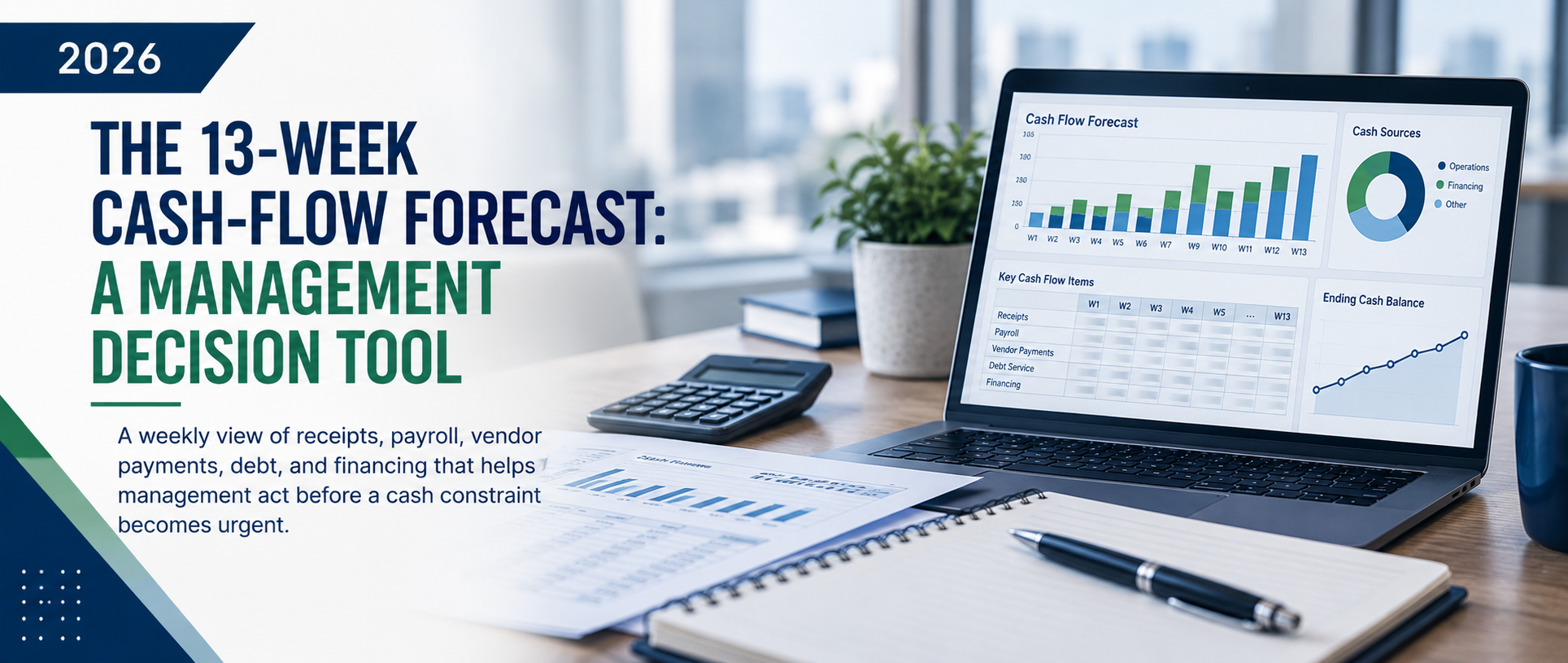
Suggested: CFO reviewing a weekly cash-flow forecast spreadsheet with a liquidity threshold chart.
 –>
–>
CFO Insight
The 13-Week Cash-Flow Forecast: A Management Decision Tool
A weekly view of receipts, payroll, vendor payments, debt, and financing that helps management act before a cash constraint becomes urgent.
A 13-week cash-flow forecast is most useful when it is updated and reviewed every week. It turns expected cash movements into decisions about collections, critical payments, spending, and financing before liquidity becomes urgent.
1. Definition
A 13-week forecast is a rolling weekly view of expected cash receipts and payments over the next quarter. It starts with usable cash, adds receipts, subtracts disbursements, and shows projected ending cash by week.
It normally uses the direct method, forecasting specific cash events—such as customer collections, payroll, vendor payments, taxes, debt service, and financing—rather than starting with net income.
Opening cash + expected receipts − expected disbursements ± financing = ending cash. Each week’s ending balance becomes the next week’s opening balance.
2. Why It Matters
Profit does not answer the immediate liquidity question. A profitable business can still face a cash shortage because of slow collections, inventory purchases, payroll timing, or concentrated debt payments.
Unlike an annual budget or historical cash-flow statement, the 13-week forecast shows when cash is expected to move and when management may need to act.
Management can use it to:
- Accelerate collections: Focus on customers and weeks that matter most.
- Protect critical payments: Prioritize payroll, taxes, debt service, and essential vendors.
- Sequence spending: Decide when vendor payments, hiring, purchases, or capital spending can move.
- Plan financing: Identify when and how much credit-line or capital support may be needed.
- Communicate liquidity: Give owners, lenders, and investors a credible near-term cash plan.
3. How It Works
A useful forecast should be detailed enough to support decisions but simple enough to update weekly. Group small items into practical categories and isolate cash movements that could materially change liquidity.
| Forecast Block | What to Include | Management Question |
|---|---|---|
| Opening liquidity | Usable bank cash; identify restricted cash separately | What cash is actually available? |
| Customer receipts | Expected collections based on AR aging and payment behavior | Which receipts are dependable, and which need action? |
| Operating payments | Payroll, taxes, benefits, AP, rent, inventory, and recurring costs | What must be paid, and what can move? |
| Debt and financing | Principal, interest, revolver draws, repayments, or owner funding | Is the business self-funding, or relying on financing? |
| Ending liquidity | Projected cash and remaining availability against a minimum threshold | When does management need to intervene? |
Build Receipts from Collection Behavior
Start with open invoices and realistic collection dates—not only contractual due dates. Reflect customer payment behavior, disputes, milestone billings, card settlements, and uncertainty in timing.
Schedule Payroll and Critical Payments First
Schedule payroll, payroll taxes, benefits, required tax deposits, and debt service first using actual funding dates. Then prioritize vendor payments by operational importance, contractual consequences, and available terms.
Keep Financing Visible
Show revolver draws, owner funding, and other financing separately from operating receipts. This distinguishes cash generated by operations from liquidity supported by external funding.
Add a Downside Case and Minimum Cash Threshold
Use a supportable base case plus at least one specific downside case—for example, a major collection arriving late. Set a minimum liquidity threshold tied to payroll, essential operations, lender requirements, and financing lead time.
Review Variances and Roll Forward Weekly
Each week, replace forecasts with actuals, explain material variances, revise assumptions, and add a new Week 13. Repeated misses should improve the forecasting assumption or process—not just create another variance note.
4. Simple Example
A services company starts Week 1 with $420,000 of cash and a $200,000 minimum liquidity threshold. Its base case stays above the threshold.
In the downside case, a $280,000 customer payment slips from Week 4 to Week 6, pushing Week 5 cash to $145,000. Because the shortfall appears early, management can accelerate collections, delay discretionary spending, negotiate a vendor payment, and confirm revolver availability before payroll is at risk.
The forecast does not make the decision. It shows the timing, size, and cause of the constraint so management can choose the least disruptive response.
5. Common Mistakes
- Starting with profit instead of cash timing: Forecast scheduled receipts and payments directly.
- Using invoice due dates only: Reflect actual customer payment behavior.
- Forecasting payroll by pay period: Use the actual bank-funding date.
- Hiding financing in operations: Show draws and repayments separately.
- Using only an optimistic case: Include a defined downside scenario and minimum cash threshold.
- Overbuilding the model: Keep enough detail for decisions without making weekly maintenance impractical.
- Updating numbers without action owners: Assign responsibility for collections, payments, spending, and financing actions.
Quick Answers
- Only for distressed businesses? No. It is also useful during rapid growth, seasonality, major hiring, capital investment, fundraising, or acquisitions.
- How often should it be updated? Normally every week. Businesses with tighter liquidity may refresh key cash items more frequently while keeping the weekly management review.
6. Practical Checklist: What’s Next
Work through these items when building or refreshing the forecast.
0 of 8 complete
PNJ Perspective
A 13-week forecast is most valuable when it connects AR collections, payroll, vendor payments, debt, financing, and management thresholds in one weekly process. PNJ can help build the model around actual cash behavior and turn forecast-to-actual variances into specific management actions.
Technical Reference Points
- Association for Financial Professionals: Cash Forecasting Resources
- SBA: Manage Your Finances
Disclaimer
This article provides general educational information and does not constitute financial, accounting, lending, or investment advice. Forecast design, liquidity thresholds, and financing decisions should be tailored to the company’s operations, agreements, and circumstances.