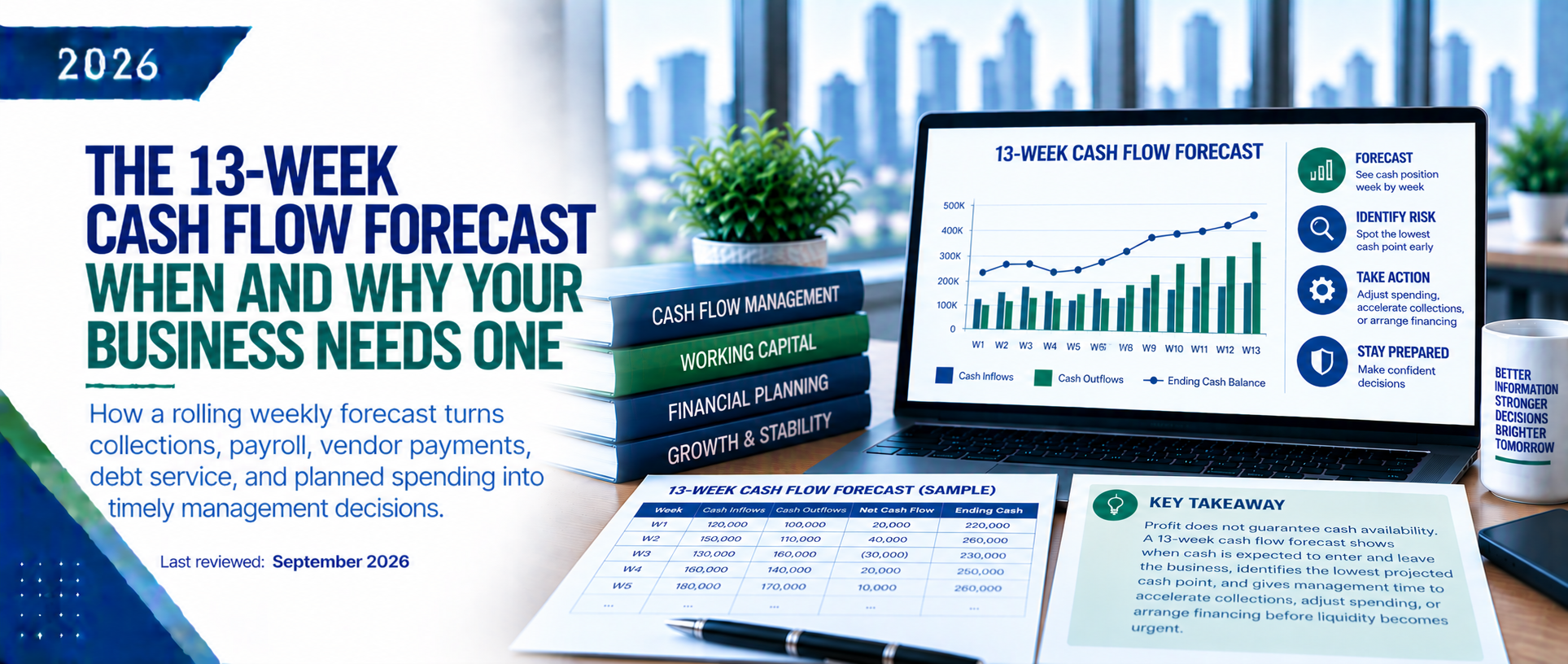
Suggested: a CFO or controller reviewing a rolling weekly cash forecast spreadsheet with a bank balance trend line on screen.
 –>
–>
Business Insight Practice Guide
The 13-Week Cash Flow Forecast: When and Why Your Business Needs One
How a rolling weekly forecast turns collections, payroll, vendor payments, debt service, and planned spending into timely management decisions
Profit does not guarantee cash availability. A 13-week cash flow forecast shows when cash is expected to enter and leave the business, identifies the lowest projected cash point, and gives management time to accelerate collections, adjust spending, or arrange financing before liquidity becomes urgent.
1. Definition
A 13-week cash flow forecast is a rolling weekly liquidity model that projects cash receipts, cash disbursements, and ending bank balances. Thirteen weeks is long enough to reveal upcoming pressure but short enough to use invoice-level and payment-specific data.
Start with actual available cash. Each week adds expected collections and other receipts, subtracts payroll, taxes, vendors, debt service, capital spending, and other payments, then compares projected ending cash with a minimum liquidity threshold.
2. Why It Matters and When It Is Needed
- Profit is not cash: Revenue may be recognized before collection, while loan principal, capital spending, taxes, and owner distributions use cash without appearing as ordinary operating expenses.
- Weekly timing matters: A monthly forecast can hide a short-term funding gap when payroll or other major payments occur before customer cash arrives.
A 13-Week Forecast Is Especially Useful When:
- Liquidity is tight: cash reserves are declining or there is little room for collection delays.
- AR is growing: receivables are rising faster than revenue or customers pay unpredictably.
- Spending is increasing: the business is hiring, purchasing inventory, or investing in capital projects.
- Debt matters: debt service, lender reporting, or liquidity covenants require closer monitoring.
- Cash flow is uneven: revenue is seasonal, customers are concentrated, or several large payments fall together.
- A major event is coming: financing, restructuring, acquisition, or turnaround planning is underway.
3. How It Works
Build from Actual Cash and Operating Detail
Begin with reconciled bank balances and exclude restricted cash. Do not copy accrual P&L totals into the forecast; convert accounting data into the dates cash is expected to enter or leave the bank.
Forecast Receipts by Source and Confidence
Forecast customer collections from open invoices, billing schedules, processor timing, and customer payment behavior. Separate reliable recurring receipts from disputed, delayed, or conditional amounts, and include other supportable receipts such as deposits, refunds, asset-sale proceeds, financing draws, or owner contributions.
Forecast Payments by Timing and Priority
Include payroll, taxes, rent, software, critical vendors, inventory, debt principal and interest, capex, owner distributions, and significant one-time costs. Distinguish fixed obligations from payments that management can reasonably reschedule.
Set a Minimum Cash Threshold
Define a minimum cash threshold based on payroll, taxes, essential vendors, debt requirements, and financing lead time. A separate management target can provide additional cushion.
Use Scenarios When Uncertainty Is Material
Use three views when uncertainty is material:
- Base case: most likely timing.
- Downside case: delayed receipts or higher costs.
- Action case: specific responses such as faster collections, delayed spending, or a credit-line draw.
Roll the Forecast and Review Variances Weekly
Update the forecast weekly: replace estimates with actuals, explain material variances, remove the completed week, and add a new Week 13. Repeated misses often reveal optimistic collection assumptions, incomplete vendor data, or outdated payment schedules.
4. Simple Example
Example: A profitable company starts with $300,000 available cash and recognizes $500,000 of revenue, but only $180,000 will be collected before major obligations are paid.
| Cash Item | Amount | Management Meaning |
|---|---|---|
| Beginning available cash | $300,000 | Starting liquidity |
| Customer collections | +$180,000 | Cash received, not revenue recognized |
| Payroll and payroll taxes | ($220,000) | Fixed near-term obligation |
| Vendor payments | ($140,000) | Operating commitments |
| Debt service | ($50,000) | Principal and interest due |
| Projected ending cash | $70,000 | Below the $150,000 minimum threshold |
Projected ending cash is $70,000—$80,000 below the $150,000 minimum threshold. Management now has time to accelerate collections, prioritize payments, delay discretionary spending, or arrange temporary financing. The forecast does not make the decision; it shows when action is needed and how much.
5. Common Mistakes and Quick Answers
Common Mistakes
- Using the annual budget as a cash forecast: convert accrual assumptions into actual cash dates.
- Forecasting collections from revenue percentages: use invoice-level and customer-specific data.
- Treating every receipt as equally certain: separate high-confidence from disputed or delayed cash.
- Omitting major cash uses: include taxes, debt principal, capex, and owner distributions.
- Starting with unreconciled cash: tie beginning cash and prior-week activity to the bank.
- Overengineering the model: keep it detailed enough to explain movements but simple enough to update weekly.
- Reporting a gap without an action plan: assign actions, owners, and deadlines.
Is a 13-Week Forecast Only for Distressed Businesses?
No. It is especially useful when liquidity is tight, but healthy and growing businesses also use it to plan hiring, inventory, capital purchases, distributions, and financing without creating avoidable cash pressure.
Does the Forecast Replace the Budget?
No. The budget measures expected performance over a longer period; the 13-week forecast manages near-term cash timing. They should be consistent, but they answer different management questions.
6. Practical Checklist: What’s Next
Route each role’s action item as the forecast is built and rolled forward each week.
0 of 5 complete
Update the forecast on the same day each week, review the lowest projected cash balance, compare forecast to actual, and assign actions before the threshold is breached. Keep the model simple enough to maintain and detailed enough to explain each material movement.
PNJ Perspective
A useful 13-week forecast is not just a spreadsheet—it is a weekly management process that connects AR, AP, payroll, taxes, debt, and planned spending to specific liquidity decisions. PNJ helps businesses build and maintain the model, test scenarios, and turn projected cash gaps into timely actions.
Technical Reference Points
- Beginning Cash Reconciliation
- AR Collection Timing
- AP & Payroll Scheduling
- Minimum Liquidity Threshold
- Weekly Variance Review
Disclaimer
This article provides general business and financial-management information and is not investment, lending, accounting, tax, or legal advice. Forecast results depend on the quality of underlying data and assumptions.