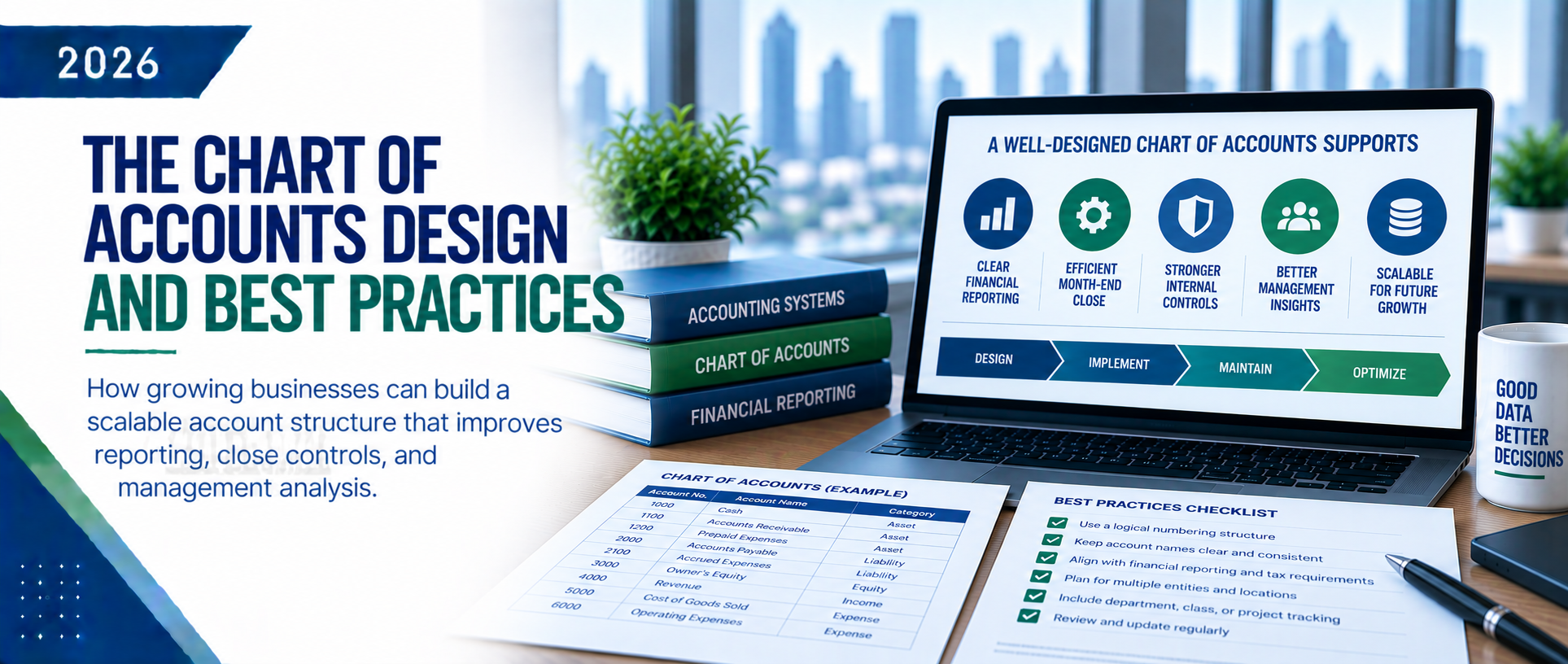
Suggested: Controller reviewing a chart of accounts and numbering structure on a laptop.
 –>
–>
Accounting Practice Guide | Intermediate
The Chart of Accounts: Design and Best Practices
How growing businesses can build a scalable account structure that improves reporting, close controls, and management analysis.
A strong chart of accounts (COA) is detailed enough to explain the business but simple enough to use consistently. Use the general ledger for accounting classification and subledgers/dimensions for customer, vendor, department, location, product, and project detail. Clear ownership and change controls keep the structure reliable as the company grows.
1. Definition
The chart of accounts (COA) is the organized list of GL accounts used to classify transactions. Each account typically has a number, name, financial-statement type, and defined purpose and rolls into assets, liabilities, equity, revenue, cost of revenue, operating expenses, or other income/expense.
The COA is the reporting architecture of the accounting system. It determines where transactions appear on the financial statements, while subledgers and dimensions usually hold customer, vendor, department, location, product, and project detail.
2. Why It Matters
- Poor design creates rework: Duplicate or vague accounts lead to inconsistent coding, delayed reconciliations, unreliable gross margin, and manual regrouping.
- Good design improves decisions: A stable COA supports clear account ownership, meaningful comparisons, budgeting, tax mappings, audit support, integrations, and a faster close.
3. How It Works
Start With the Reports Management Needs
Design from the financial statements backward. Identify the reporting lines, operating metrics, and lender, investor, tax, or regulatory needs. The COA should produce those views without repeated spreadsheet regrouping.
Build a Logical Numbering Structure
Use account numbers that make the financial-statement order easy to follow. The specific ranges are a company policy, not a U.S. GAAP rule. Consistency matters more than the exact numbering, and gaps should be left for future accounts.
| Number Range | Category | Illustrative Accounts |
|---|---|---|
| 1000 to 1999 | Assets | Cash, receivables, inventory, prepaids, fixed assets |
| 2000 to 2999 | Liabilities | Payables, accruals, payroll liabilities, debt |
| 3000 to 3999 | Equity | Capital, retained earnings, distributions |
| 4000 to 4999 | Revenue | Product, service, subscription revenue |
| 5000 to 5999 | Cost of revenue | Direct labor, hosting, materials, fulfillment |
| 6000 to 7999 | Operating expenses | Payroll, marketing, software, professional fees |
| 8000 to 8999 | Other income and expense | Interest, gains, losses, nonoperating items |
Use Accounts for Classification and Dimensions for Analysis
Create a separate GL account when information changes accounting treatment, financial-statement presentation, reconciliation, or a recurring management decision. Use a dimension or subledger when management only needs another analytical view of the same account.
| Information Need | Recommended Structure | Avoid |
|---|---|---|
| Department performance | Department or class dimension | Separate wage and software accounts for every department |
| Project profitability | Project or job dimension | Project-specific general-ledger accounts |
| Customer or vendor detail | AR or AP subledger | An account for each customer or vendor |
| Revenue stream with different economics | Separate revenue account | Combining material product and service revenue |
Protect Gross Margin and Balance Sheet Integrity
Revenue accounts should reflect meaningful business lines, and cost-of-revenue accounts should capture costs directly related to delivery. Consistent separation from operating expenses protects gross-margin integrity. Document treatment for items such as hosting, direct labor, fulfillment, and payment processing.
Balance-sheet accounts need stronger control because balances carry forward. Bank accounts should generally have separate GL accounts; AR/AP should tie to subledgers; and prepaids, fixed assets, debt, and accruals should tie to supporting schedules with an owner and reviewer.
Set Naming and Change Rules
Use names that remain understandable when employees or vendors change. Prefer functional names such as Professional Fees – Legal instead of individual firm names. Define what belongs in high-use accounts and review Other, Miscellaneous, Suspense, and Uncategorized balances monthly.
Restrict account creation, renaming, merging, deactivation, and type changes to authorized accounting personnel. Before adding an account, confirm that an existing account or dimension cannot meet the need. Preserve history and test impacts on budgets, tax mappings, integrations, and comparative reporting.
4. Simple Example
A growing company has 35 software expense accounts, including separate accounts for its accounting, CRM, communication, storage, and smaller tools. Staff code invoices inconsistently, yet management reviews only total software cost and four functional categories.
- Simplify the GL: Create a parent Software and Technology category with Accounting, CRM, Collaboration, and Other Software subaccounts.
- Keep vendor detail in AP: Track individual suppliers in the AP subledger—not separate GL accounts.
- Preserve history: Map old accounts to the new structure, confirm comparative reports, and deactivate rather than delete redundant accounts.
- Control future changes: Require Controller approval before another software account is created.
Result: The income statement becomes easier to read, vendor-level detail remains available, and coding is more consistent. The company reduces 35 software accounts to a useful summary without losing analytical detail.
5. Common Mistakes and Quick Answers
Common Mistakes
- Creating a GL account for every customer, vendor, product, project, or department: Use subledgers or dimensions when the detail is analytical rather than accounting-driven.
- Combining revenue and direct costs—or relying on Other/Miscellaneous: This can weaken gross-margin reporting and hide unresolved coding.
How Detailed Should the COA Be?
Only as detailed as reporting and control needs justify. Add an account when it improves classification, reconciliation, compliance, or a recurring management decision. If the need is mainly who, where, or which project, a dimension or subledger is usually more scalable.
When Should the COA Be Redesigned?
Redesign may be appropriate after a major new revenue stream, system change, financing/audit preparation, multi-entity standardization, or persistent reporting inconsistency. Minor issues may be solved through policies, mappings, or selective deactivation rather than a full redesign.
6. Practical Checklist: What’s Next
Work through these role-based items when designing or reviewing the chart of accounts.
0 of 7 complete
PNJ Perspective
A scalable COA should produce reliable reporting without unnecessary account complexity. PNJ helps businesses align account structure, subledgers, dimensions, gross-margin classification, balance-sheet reconciliations, and change controls so the accounting system remains consistent as the business grows.
Technical Reference Points
- Financial-Statement Classification
- Subledgers & Dimensions
- Gross-Margin Structure
- Balance-Sheet Reconciliation
- COA Change Governance
Disclaimer
This article provides general educational information and is not accounting, tax, legal, systems, or internal-control advice. The appropriate chart of accounts depends on the company’s reporting framework, industry, systems, transaction volume, tax requirements, and management needs. Consult qualified advisers regarding specific circumstances.