Suggested: client and outsourced Controller reviewing a monthly reporting package together.
 –>
–>
Client Experience
What Clients Should Expect from an Outsourced Controller
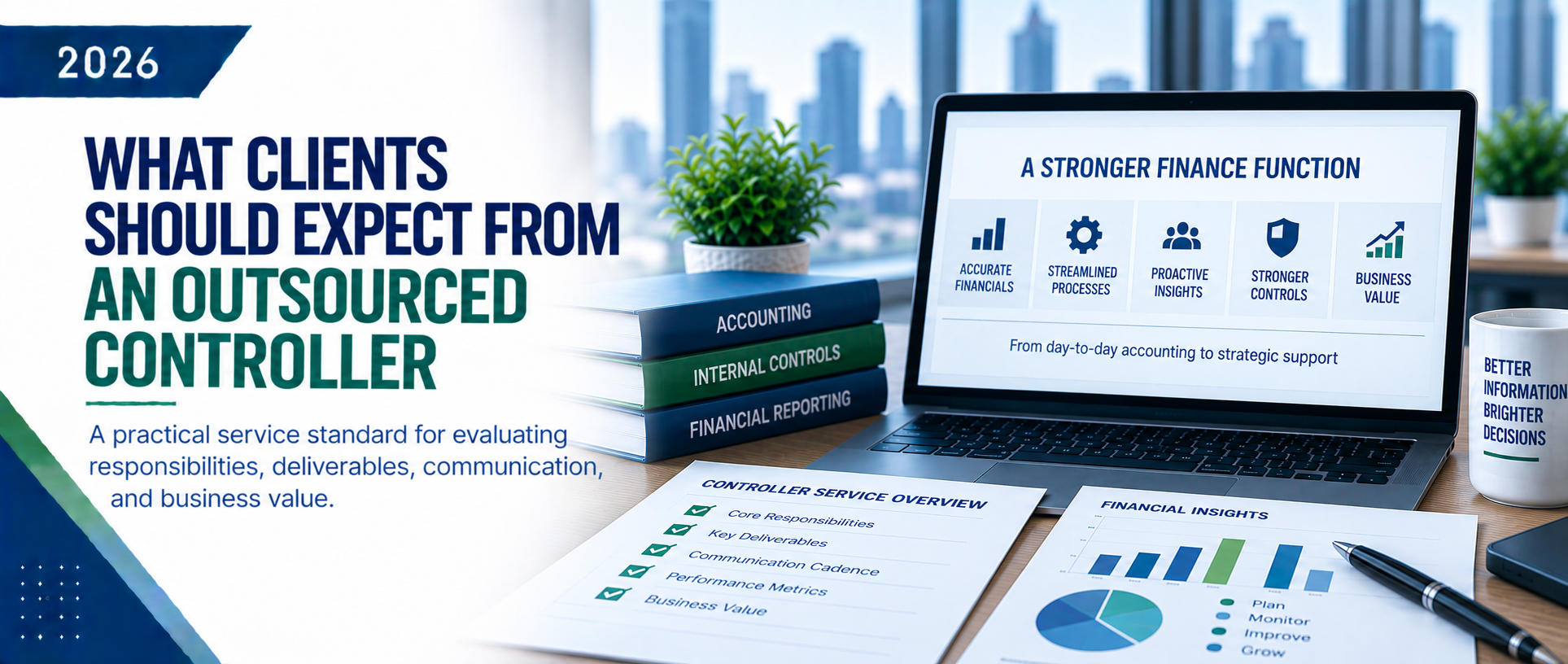
A practical service standard for evaluating responsibilities, deliverables, communication, and business value.
An outsourced Controller should provide more than bookkeeping. Clients should expect clear ownership, a dependable close, reconciled financial statements, AR/AP and cash oversight, useful management reporting, stronger controls, and clear escalation. The engagement works best when provider responsibilities and client inputs/approvals are documented from the start.
1. Definition: What an Outsourced Controller Does
An outsourced Controller manages the reliability and discipline of the accounting function. The role sits between transaction processing and CFO-level strategy:
- Bookkeeper: records activity.
- Controller: verifies accounting, manages the close, reviews reporting, and investigates issues.
- CFO: uses reliable financial information for financing, planning, and broader strategy.
The Controller may supervise an internal bookkeeper, an outsourced team, or both. Daily bookkeeping, bill payment, collections, and payroll should not be assumed. The service agreement should state what is included, who performs it, and who approves it.
2. Why the Client Experience Matters
- Visibility: Outsourcing changes who performs the work, but management still needs clear accountability and timely information.
- Predictability: Management should know when the books will close, which numbers are reliable, and whom to contact.
The goal is a controlled finance function: accurate information, clear responsibilities, consistent deadlines, documented review, and early warning when management must act.
3. How a Strong Engagement Should Work
A Defined Scope and Responsibility Map
Start with a written scope, close calendar, reporting calendar, and responsibility matrix. Separate preparation from approval and identify client dependencies—such as access, contracts, inventory data, payroll reports, expenses, and estimates—before they delay the close.
A Predictable, Controlled Month-End Close
Set a committed close target and repeatable checklist. Before reports are released, the Controller should review cutoff, accruals, revenue, payroll, fixed assets, intercompany activity, and unusual transactions.
A Fully Supported Balance Sheet
A trial balance is not a reconciled balance sheet. Material accounts should have independent support—bank statements, subledgers, schedules, contracts, or third-party reports. Reconciling items need an owner and resolution date; old unexplained balances should not simply roll forward.
Oversight of AR, AP, and Cash
Controller-level service should connect accounting to the operating cash cycle. Management should expect review of overdue AR, unbilled amounts, vendor aging, unusual payments, upcoming obligations, and liquidity. The Controller may not process every transaction, but should ensure the processes reconcile and exceptions are escalated.
Management Reporting With Explanations
A useful monthly package normally includes the balance sheet, income statement, cash-flow information, and relevant comparisons. The Controller should explain what changed, why, whether it is recurring, and what management should review next.
Internal Controls and Escalation
The Controller should help establish approvals, access restrictions, segregation of duties, and review evidence. Tax, legal, audit, valuation, technical-accounting, or CFO-level issues should follow a defined escalation path rather than remain unresolved.
Communication That Is Structured and Responsive
Clients should know the primary contact, meeting cadence, response-time expectations, and escalation contact. Requests should be acknowledged, assigned, tracked, and resolved, with brief status updates during onboarding and close when needed.
4. Common Mistakes
- Buying the title instead of the deliverables: Define exactly what Controller service includes.
- Assuming everything is included: Bookkeeping, bill pay, collections, payroll, tax, and CFO advisory may be separate.
- Expecting a fast close with late inputs: Client contracts, approvals, inventory data, and expenses must arrive on time.
- Accepting unsupported reports: Require reconciliations, schedules, review evidence, and explanations.
- Leaving authority undocumented: Document access, approvals, data ownership, and termination procedures.
5. Practical Responsibility Checklist: Who Is in Charge?
Outsourcing the Controller role does not transfer every financial responsibility to the provider. Use the table below as a starting point, then document the final allocation in the engagement letter and responsibility matrix.
| Responsibility | Primary Owner | What Each Party Should Do |
|---|---|---|
| Scope, calendar, and deliverables | Joint | Controller proposes workflow and deadlines; client leadership confirms priorities, entities, systems, and exclusions. |
| Close, reconciliations, and reports | Outsourced Controller | Prepare or supervise the close, review support, track open items, and deliver the agreed reporting package. |
| Records, estimates, and approvals | Client Management | Provide timely contracts, payroll/inventory data, management estimates, and required approvals. |
| AR, AP, payroll, and cash | Joint | Controller monitors accuracy and exceptions; management authorizes payments, credit decisions, payroll changes, and collection actions. |
| Access, controls, and data ownership | Client Management | Management retains bank/system authority; Controller recommends controls and works within approved permissions. |
| Escalation and service review | Joint | Controller raises unresolved or out-of-scope issues; client sponsor makes decisions and reviews service quality. |
The outsourced Controller owns the accounting process within scope. Client management retains responsibility for business decisions, approvals, complete information, and oversight.
PNJ Perspective
A strong outsourced Controller relationship should make the finance function more reliable, more visible, and easier to manage. PNJ focuses on close ownership, reconciled reporting, AR/AP and cash oversight, practical controls, clear communication, and defined escalation—with responsibilities documented so both the provider and client know who owns what.
Technical Reference Points
- Defined Scope & Responsibility Matrix
- Close & Reporting Calendar
- Reconciled Balance Sheet
- AR/AP & Cash Oversight
- Control & Escalation Path
Disclaimer
This article provides general educational information and is not accounting, tax, legal, audit, or investment advice. Scope and responsibilities vary by engagement. Review the service agreement and consult qualified advisers regarding your company’s needs.