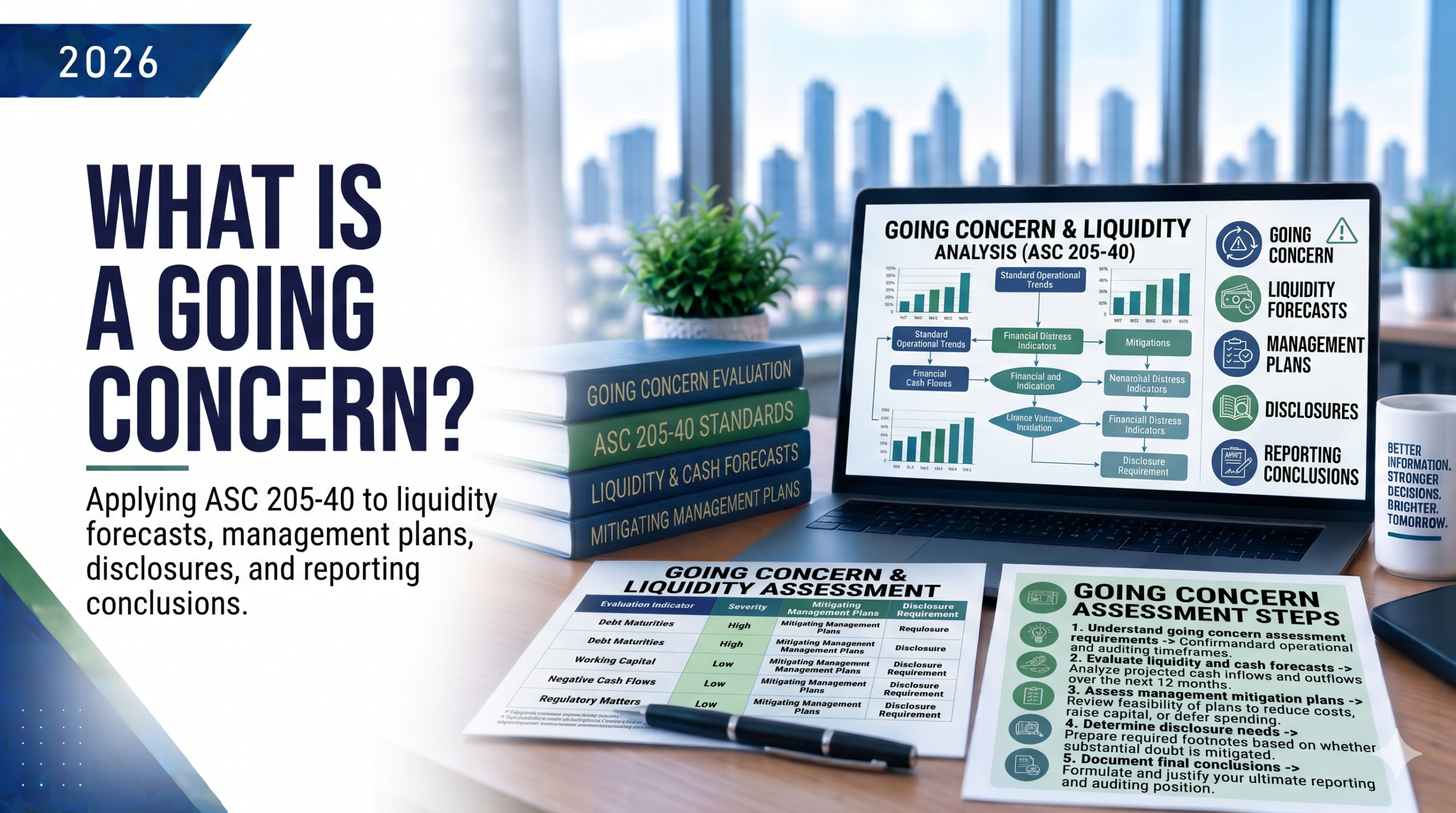
Suggested: Finance professional reviewing a monthly cash-flow forecast on a laptop and printed projections at a desk.
 –>
Accounting | Advanced Technical Guide
What Is a Going Concern?
Applying ASC 205-40 to liquidity forecasts management plans disclosures and reporting conclusions
1. What Is a Going Concern?
A going concern is a business that is expected to continue operating and meet its financial obligations rather than face imminent liquidation.
Under U.S. Generally Accepted Accounting Principles (U.S. GAAP), the going concern assumption provides the foundation for preparing financial statements under normal accounting principles.
ASC 205-40, Presentation of Financial Statements—Going Concern, requires management to evaluate whether conditions and events raise substantial doubt about the entity’s ability to continue as a going concern.
Substantial doubt exists when it is probable that the company will be unable to meet its obligations as they become due within one year after the financial statements are issued or available to be issued, as applicable.
Importantly, substantial doubt does not automatically mean the company must stop operating or adopt liquidation accounting.
2. Why Does Going Concern Matter in Business?
The going concern assessment affects financial reporting, financing decisions, and stakeholders’ understanding of financial risk.
- Financial Statement Reliability: The assumption supports normal accounting for assets, liabilities, depreciation, and other financial statement items.
- Liquidity and Solvency Assessment: Management must evaluate whether sufficient financial resources are available to meet upcoming obligations.
- Lender and Investor Confidence: Going concern disclosures provide important information about financial uncertainty and management’s plans.
- U.S. GAAP Compliance: ASC 205-40 establishes specific management assessment and disclosure requirements.
- Business Continuity Planning: Financial difficulties may highlight the need for additional financing, restructuring, or cost reductions.
A profitable company can still face going concern uncertainty if it lacks sufficient cash to meet its obligations. Conversely, a company reporting losses may remain financially viable if adequate liquidity and reliable funding are available.
3. How Does Going Concern Work Under U.S. GAAP?
ASC 205-40 requires management to evaluate financial conditions, expected obligations, and potential mitigating plans.
A. Identify conditions that may raise substantial doubt
- Recurring operating losses and persistent negative cash flows.
- Working capital deficiencies or insufficient liquidity.
- Upcoming debt maturities without reliable repayment or refinancing sources.
- Debt covenant violations or restricted access to financing.
- Loss of major customers, key suppliers, or essential operating resources.
- Significant litigation or regulatory issues that threaten business operations.
These indicators must be evaluated collectively; no single indicator automatically establishes substantial doubt.
B. Evaluate management’s plans
When substantial doubt is initially raised, management considers whether its plans can alleviate that doubt. Possible actions include obtaining additional financing, negotiating debt extensions, reducing operating expenses, or selling nonessential assets.
Under ASC 205-40, plans alleviate substantial doubt only when both their effective implementation and their ability to mitigate the relevant conditions are probable.
C. Determine financial statement implications
- No substantial doubt identified: No going concern disclosure is required solely under ASC 205-40.
- Substantial doubt raised but alleviated: Disclose the principal conditions, management’s evaluation, and mitigating plans.
- Substantial doubt not alleviated: Disclose the conditions, management’s evaluation and plans, and explicitly state that substantial doubt exists.
Substantial doubt under ASC 205-40 does not automatically require liquidation-basis accounting. ASC 205-30 governs liquidation-basis accounting when liquidation becomes imminent and its requirements apply.
4. Practical Example: Going Concern Assessment
ABC Software Inc., a U.S. SaaS company, prepares financial statements for the year ended December 31, 2026, to be issued on March 31, 2027. Management estimates the following cash flows through March 31, 2028:
| Financial information | Amount |
|---|---|
| Available cash | $350,000 |
| Expected cash inflows | $1,800,000 |
| Expected operating cash outflows | ($2,400,000) |
| Debt repayment obligations | ($500,000) |
| Projected funding shortfall | ($750,000) |
Assume monthly cash forecasts confirm the company cannot meet certain obligations when due without additional financing.
Scenario A — Substantial Doubt Remains
Management expects to raise $1 million from investors but has no sufficiently supported financing commitments. Because the proposed financing has not met ASC 205-40’s probability criteria, substantial doubt remains, and the company must provide the required disclosures.
Scenario B — Substantial Doubt Is Alleviated
Management secures $1 million in enforceable financing commitments and implements supported cost reductions. Assume the plans meet both probability criteria and monthly cash forecasts demonstrate sufficient liquidity throughout the assessment period.
In this case, substantial doubt may be alleviated, but the company must still disclose the conditions that originally raised doubt and the plans that addressed them.
Going concern is primarily an assessment of the company’s ability to meet obligations as they become due, not simply whether it generates accounting profits.
5. Common Misunderstandings About Going Concern
- Misconception: Operating losses automatically mean a company is not a going concern. Not necessarily. Losses are warning indicators, but the conclusion depends on liquidity, available funding, and expected obligations.
- Misconception: Positive net income eliminates going concern risks. Incorrect. A profitable business may still experience serious cash shortages or be unable to repay maturing debt.
- Misconception: Management’s fundraising plans automatically resolve substantial doubt. Incorrect. Management must provide sufficient evidence that the plans are probable of being effectively implemented and probable of mitigating the uncertainty.
- Misconception: Substantial doubt requires liquidation accounting. Incorrect. Going concern uncertainty under ASC 205-40 and imminent liquidation under ASC 205-30 are separate accounting considerations.
- Misconception: Going concern assessments are only required for audited companies. Incorrect. Management’s assessment requirements apply to entities preparing annual or interim financial statements under U.S. GAAP, regardless of whether those statements are audited.
6. Key Takeaways and Business Considerations
A going concern assessment is a critical component of reliable financial reporting and financial risk management.
- ASC 205-40 requires a forward-looking evaluation covering one year after financial statements are issued or available to be issued.
- Liquidity and contractual obligations are central to determining whether substantial doubt exists.
- Management’s mitigating plans must be supported by evidence demonstrating probable implementation and effectiveness.
- Financial statement disclosures may be required even when management successfully alleviates substantial doubt.
- Going concern uncertainty does not automatically trigger liquidation accounting.
Businesses facing financial uncertainty should maintain reliable cash flow forecasts, monitor debt obligations, evaluate available financing, and ensure financial statement disclosures accurately reflect their circumstances.
How PNJ Group Can Help
PNJ Group supports businesses through U.S. GAAP financial reporting, cash flow forecasting, liquidity analysis, controller services, and fractional CFO advisory.
Our accounting and financial advisory services help management understand financial risks, evaluate business continuity, and make informed financial decisions.
Technical References
- FASB ASC 205-40 (Going Concern)
- FASB ASC 205-30 (Liquidation Basis of Accounting)
- PCAOB AS 2415 (Consideration of an Entity’s Ability to Continue as a Going Concern)
Disclaimer
This article provides general accounting information under U.S. GAAP and is not intended as an entity-specific accounting conclusion or audit opinion.