Suggested: LLC owner comparing payroll and profit numbers with a tax adviser.
 –>
Tax Foundation
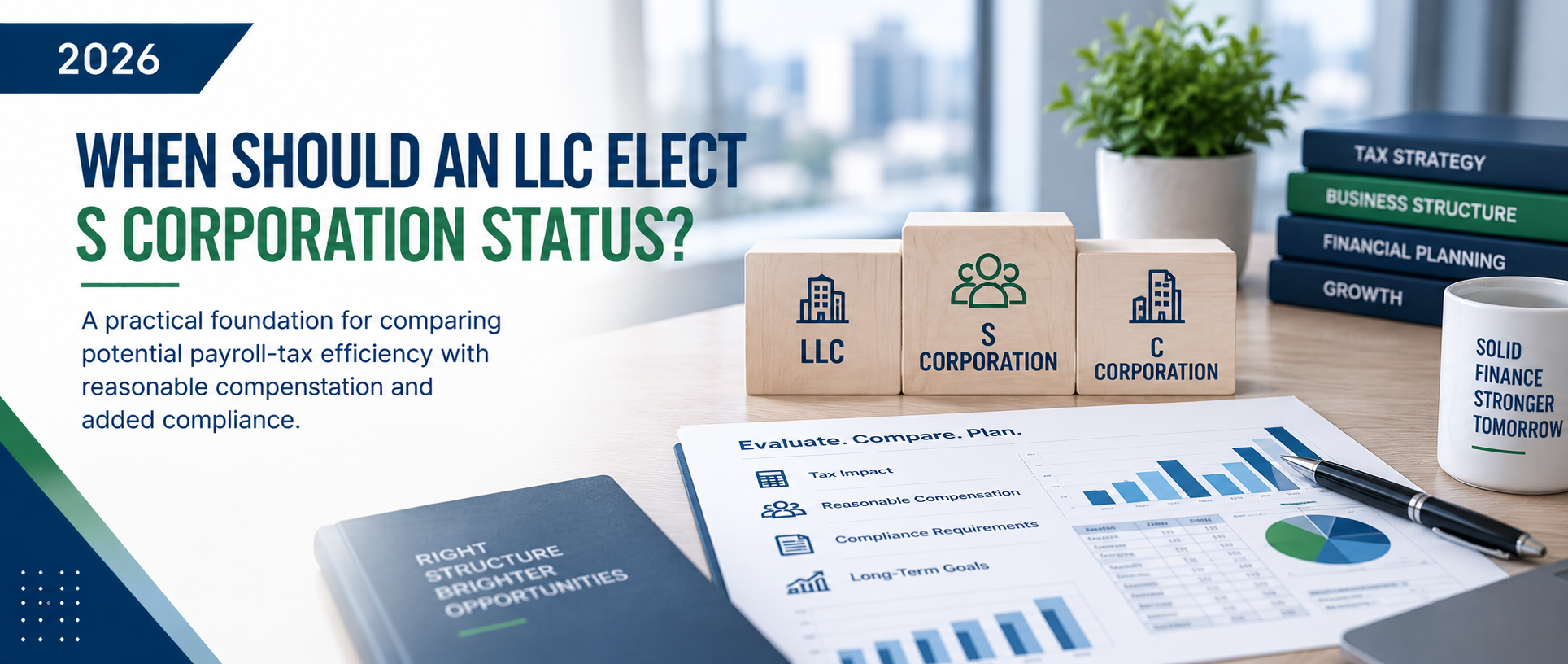
When Should an LLC Elect S Corporation Status?
A practical foundation for comparing potential payroll-tax efficiency with reasonable compensation and added compliance.
An S election may make sense when an owner-operated LLC has stable profit above reasonable compensation and the expected payroll-tax benefit exceeds payroll, tax, accounting, and state compliance costs. There is no universal IRS profit threshold.
1. Definition
- LLC legal structure: An LLC is created under state law. A single-member LLC is generally disregarded for federal income tax; a multi-member LLC is generally taxed as a partnership unless another classification is elected.
- S corporation election: An eligible LLC may file Form 2553 and remain an LLC legally while filing Form 1120-S, issuing Schedule K-1, and following S corporation tax rules.
- Working owners: A shareholder-employee generally must receive reasonable W-2 compensation before taking additional non-wage distributions.
2. Why It Matters
- Potential benefit: Owner wages are subject to payroll tax, while remaining S corporation pass-through profit generally is not subject to self-employment tax. Both generally remain subject to income tax.
- Added responsibility: Payroll, tax deposits, W-2, Form 1120-S, basis tracking, stronger bookkeeping, and state compliance add recurring cost and administration.
Choose the election only when the net recurring benefit remains meaningful after reasonable compensation and full compliance costs.
3. How It Works
Step 1: Confirm Eligibility
- Federal eligibility: Generally domestic, no more than 100 shareholders, eligible shareholders, and one class of stock.
- Operating agreement: For multi-member LLCs, review special allocations, preferred returns, unequal distribution rights, and redemption provisions for S corporation compatibility.
Step 2: Determine Reasonable Compensation
Reasonable compensation is the center of the analysis. There is no automatic salary percentage; compensation should reflect the work actually performed.
Key factors include:
- Owner role and effort: training, experience, duties, responsibilities, and time devoted.
- Market compensation: what comparable businesses pay for similar services.
- How revenue is generated: owner services versus employees, capital, or equipment.
- Company compensation pattern: payments to other employees and the history of wages and distributions.
Setting salary as an arbitrary percentage of profit. Reasonable compensation must be supported by the facts.
Step 3: Decide Whether the Economics Are Strong Enough
There is no IRS profit threshold. The election is more compelling when these conditions exist together:
- Stable profit: earnings are recurring, not a one-time spike.
- Profit above salary: expected profit is meaningfully higher than supportable owner compensation.
- Net savings: payroll-tax savings exceed payroll, tax preparation, bookkeeping, state fees, and other recurring costs.
- Operational readiness: books are reliable, cash supports payroll deposits, and owners remain eligible.
- Often not a good fit when: profit is low or volatile, nearly all profit would be reasonable compensation, savings are small, partnership-style allocations are needed, future owners may be ineligible, or the company is not ready for payroll and reliable accounting.
Step 4: Compare the Full Annual Result
| Factor | Default LLC Treatment | LLC With S Election |
|---|---|---|
| Federal return | Schedule C for a typical single-member LLC; Form 1065 for a typical multi-member LLC | Form 1120-S and Schedule K-1 |
| Working owner pay | Draws; generally no owner W-2 under default sole-proprietor or partnership treatment | Reasonable W-2 wages; possible distributions after payroll |
| Employment tax | Active earnings generally subject to applicable self-employment-tax rules | Wages subject to payroll tax; remaining pass-through profit generally is not self-employment income |
| Administration | Usually simpler | Payroll, W-2, 1120-S, basis records, and stronger bookkeeping |
| Best fit | New, low-profit, or volatile businesses; owners prioritizing simplicity | Stable profit above reasonable compensation and sufficient net savings |
Step 5: File and Implement the Election
- File on time: Form 2553 is generally due within 2 months and 15 days after the start of the effective tax year; for a calendar-year January 1 election, the normal deadline is generally March 15. Late-election relief may be available.
- Implement before the effective date: Set up payroll, tax accounts, owner-compensation and distribution procedures, clean monthly accounting, and IRS acceptance records.
4. Simple Example
Assume a single-owner consulting LLC expects $180,000 of profit before owner compensation, with $100,000 of supportable reasonable compensation.
- Default LLC: The $180,000 generally flows to Schedule C and is subject to applicable income and self-employment tax.
- S corporation: The owner receives $100,000 of W-2 wages; remaining adjusted profit passes through on Schedule K-1 and generally is not self-employment income.
- Important: The remaining profit is not tax-free. Compare the employment-tax benefit against payroll, tax preparation, bookkeeping, state taxes, and other recurring costs.
5. Common Mistakes
- Using revenue as the threshold: Start with expected profit before owner compensation—not gross sales.
- Using an arbitrary salary: Reasonable compensation must reflect the owner’s actual services and market facts.
- Taking distributions without payroll: Payments may be reclassified as wages, creating payroll tax, penalties, and interest.
- Ignoring state and recurring costs: State taxes, franchise fees, payroll filings, and professional fees can reduce the benefit.
- Electing before accounting is ready: Weak books make wages, distributions, basis, and taxable income difficult to support.
6. Practical Checklist: What’s Next
Work through these items before making or reassessing an S election.
0 of 6 complete
PNJ Perspective
An S corporation election is a business and tax decision—not simply a payroll-tax calculation. PNJ helps LLC owners compare reasonable compensation, expected tax savings, owner cash flow, state taxes, compliance costs, and implementation requirements.
Technical Reference Points
- IRS: Limited Liability Companies and S Corporation Elections
- IRS: S Corporations
- IRS: S Corporation Compensation and Medical Insurance Issues
- IRS: About Form 2553
- IRS Publication 509 (2026): Tax Calendars
Disclaimer
This article provides general educational information and is not tax or legal advice. S corporation eligibility, compensation, election timing, payroll, and state treatment depend on the facts and current law. Consult qualified tax and legal advisers before making an election.